Branding DesignAugust 4, 2026By Yash
Branding for Small Business: Design as a Growth Channel
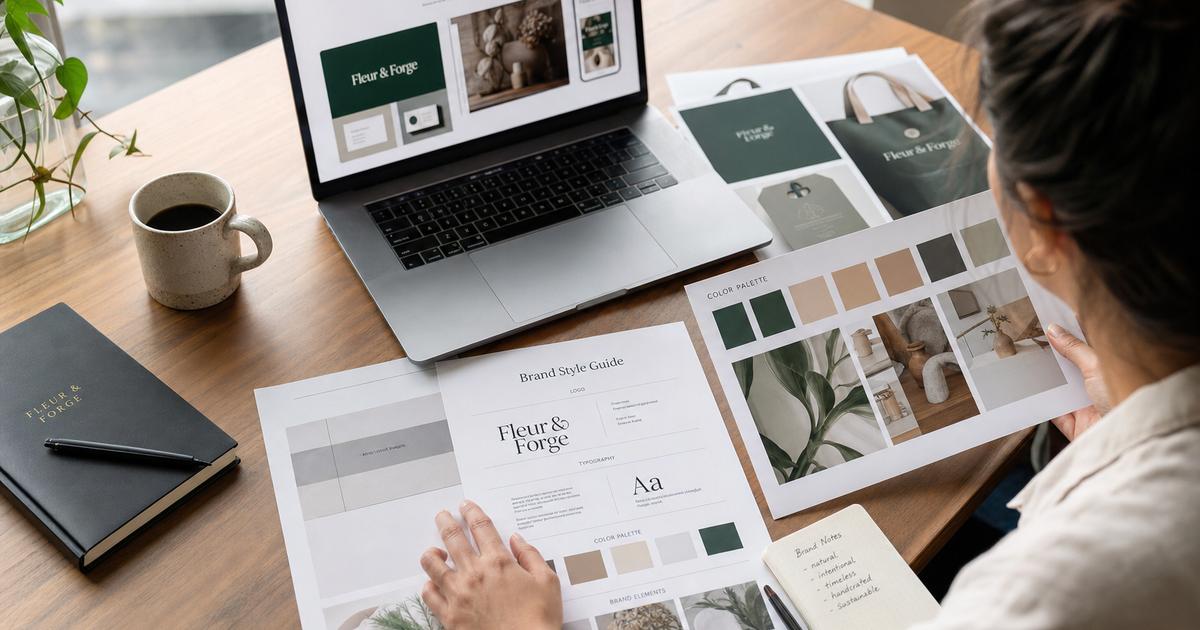
Most small business owners treat branding like a poster: hang it once, forget it's there. Then they wonder why a landing page with a great offer still converts poorly, or why a paid ad campaign that should be working isn't. Branding isn't decoration sitting on top of a business. It's one of the first things a stranger uses to decide whether to trust you at all — and that judgment happens before they read a word of your offer.
This guide covers what branding actually is, what the research says about its effect on trust and conversion, what it should cost at different budget levels, and how to decide between doing it yourself and hiring it out. Alphalead builds both the creative side of a brand and the ad and landing-page funnel it feeds into, which means we can show design's effect on real conversion numbers instead of just arguing it looks better.
Key Takeaways
- In the largest study of its kind, "design look" was the single most-cited reason people judged a website credible — mentioned in 46.1% of participant comments, more than any other factor.1
- As mobile page load time goes from 1 second to 10 seconds, the probability of a visitor bouncing increases 123% — page and design quality is a conversion lever, not a cosmetic one.3
- Full branding packages run roughly $10-$100 for DIY tools, $2,500-$10,000 for a freelance designer, and $11,000-$70,000+ for an agency. "What should I pay" has a real answer once you know which tier fits your stage.8,9,10
- Companies that maintain consistent branding self-report revenue gains of up to 33% — a real, named survey finding, but a self-reported one, not audited financial data.6
- 83% of small businesses now have a website, up from 64% in 2018, and 61% spent under $10,000 on their most recent build.7
In this guide:
- What "branding" actually means for a small business
- Does branding actually move sales?
- What should small business branding cost?
- How design quality affects conversion
- Brand consistency and why it's worth protecting
- DIY branding vs. hiring a professional
- Branding mistakes that quietly cost trust
- Where design fits inside a growth system
- FAQ
What "Branding" Actually Means for a Small Business
Branding is the identity system a business uses to be recognized and trusted: its name, logo, color palette, typography, voice, and the consistency with which all of it shows up across a website, ads, packaging, and social profiles. That's a different thing from marketing, which is the set of activities that promotes what you sell — ads, content, email, outreach. Branding is who you are. Marketing is how people find out. The two get confused constantly, enough that it's worth its own explainer — see branding vs. marketing: what's the difference and why businesses confuse them for the full breakdown.
Treating design as a separate, one-time purchase from marketing is where most small businesses go wrong. A logo commissioned once and never touched again isn't a brand system — it's an asset with no consistency behind it. A real brand system is something a business applies the same way everywhere a customer encounters it, and keeps applying as the business grows.
Does Branding Actually Move Sales? What the Research Shows
This is the fair question to ask before spending anything on design: does it actually change behavior, or is it just something that feels more professional? The strongest available evidence says design is doing real work, specifically in the trust judgment that happens before anything else.
In the largest study of its kind — a review of 2,684 participant comments on what made a website credible or not — "design look," meaning visual design and layout, was the single most-cited factor. It showed up in 46.1% of comments, ahead of every other category researchers coded, including the site's actual information structure or the perceived motive of the company behind it (Fogg et al., Stanford Persuasive Technology Lab, DUX '03).1 That study is now more than two decades old, but no comparably rigorous replacement has displaced it as the reference point researchers still cite — and a more recent industry survey points the same direction: in Adobe's 2025 study of roughly 7,000 executives and customers, 59% said they prefer browsing content that's "beautifully designed" over plain content (Adobe, 2025 AI and Digital Trends).2
That first-impression judgment also happens fast. Research out of Carleton University found visual appeal gets judged in as little as 50 milliseconds — and that near-instant snap judgment correlates with how people rate the site's usability and credibility afterward, a pattern researchers call the aesthetic-usability halo effect (Lindgaard et al., Behaviour & Information Technology, 2006).5 Fifty milliseconds is faster than a visitor can read your headline. Design forms the first opinion before your copy gets a chance to.
That trust judgment shows up again later in the funnel, at checkout. In continuously updated research from Baymard Institute, 19% of shoppers who abandoned a checkout in a recent quarter said it was because they didn't trust the site with their payment information (Baymard Institute, UX statistics).4 Trust, in other words, isn't a one-time gate at the homepage. It gets re-tested at every step a visitor takes toward becoming a customer, and design is one of the signals doing the testing.
What Should Small Business Branding Cost?
There's no single right number — cost scales with how much customization and strategy work goes into it, the same way it does for any service. But the ranges are consistent enough across independent pricing sources to give a real answer instead of a shrug.
A full branding package — logo, color system, typography, and basic brand guidelines — typically runs $10 to $100 using DIY tools and templates, $2,500 to $10,000 with a freelance designer, and $11,000 to $70,000 or more through a branding agency, depending on scope and how much strategy work is included (ManyPixels, Logo Design Cost Guide 2026; Fiverr, Logo Design Costs; We Are Tenet, Branding Cost Guide).8,9,10 These are market pricing ranges from design marketplaces and agencies, not a research study — but multiple independent guides converge on similar numbers, which is a reasonable basis for a cost benchmark.
| Provider Type | Typical Cost | Best Fit |
|---|---|---|
| DIY tools / templates | $10-$100 | Pre-revenue, validating an idea, no paid traffic yet |
| Freelance designer | $2,500-$10,000 | Early revenue, starting to invest in ads or a real website |
| Branding agency | $11,000-$70,000+ | Established revenue, protecting meaningful ad spend |
Website spend follows a similar pattern. In a 2025 survey of 406 U.S. small business owners, 83% now have a website — up from 64% in 2018 — and 61% spent under $10,000 on their most recent build, with 84% spending under $20,000 (Clutch, SMB website survey, Aug 2025).7 Cost as a reason for not having a site at all has also fallen, from 26% of holdouts in 2018 to 16% today — a sign that entry-level design and development have gotten more accessible, not that quality no longer matters.
How Design Quality Affects Website and Landing Page Conversion
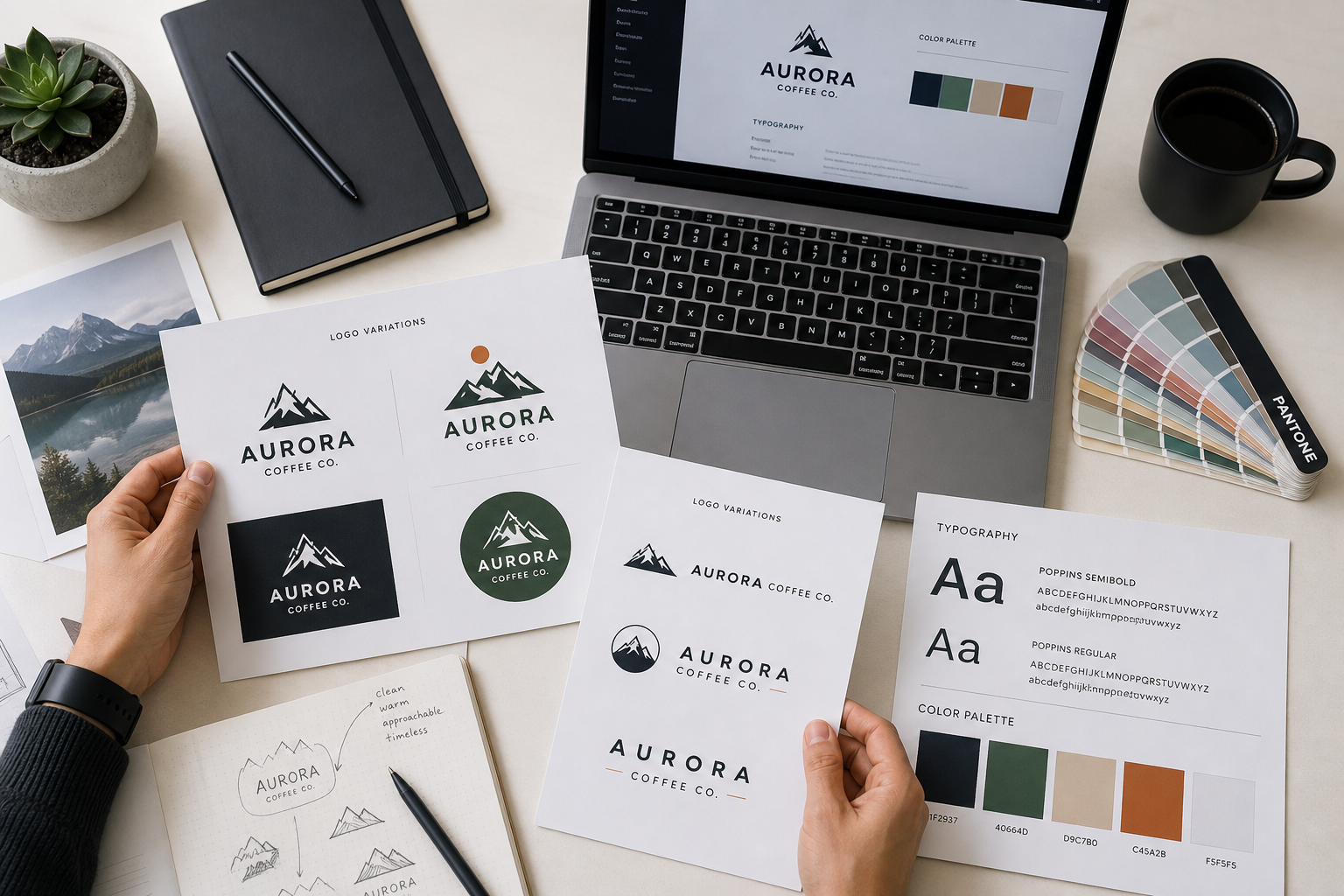
Design isn't just about how a brand looks in isolation — it's about what happens once that design has to carry a visitor through an actual funnel. Two numbers make the case plainly.
As mobile page load time increases from 1 second to 10 seconds, the probability of a visitor bouncing increases by 123%, based on Google's analysis of 900,000 mobile landing pages (Google, Think with Google Mobile Page Speed Benchmarks, 2017).3 That study is from 2017, but it remains the standard reference point for this exact relationship, and nothing about mobile attention spans has moved in the slower direction since. Page and layout design — not just raw load time — directly shapes whether a visitor sticks around long enough to see an offer at all.
The same trust signal from earlier in this guide shows up again downstream: Baymard's ongoing UX research finds that redesigning checkout and trust-signal elements can lift conversion by up to 35.26% on average for large ecommerce sites.4 A small business landing page isn't a large ecommerce checkout, but the underlying mechanism is the same — a visitor who doesn't trust what they're looking at doesn't convert, no matter how good the offer behind it is.
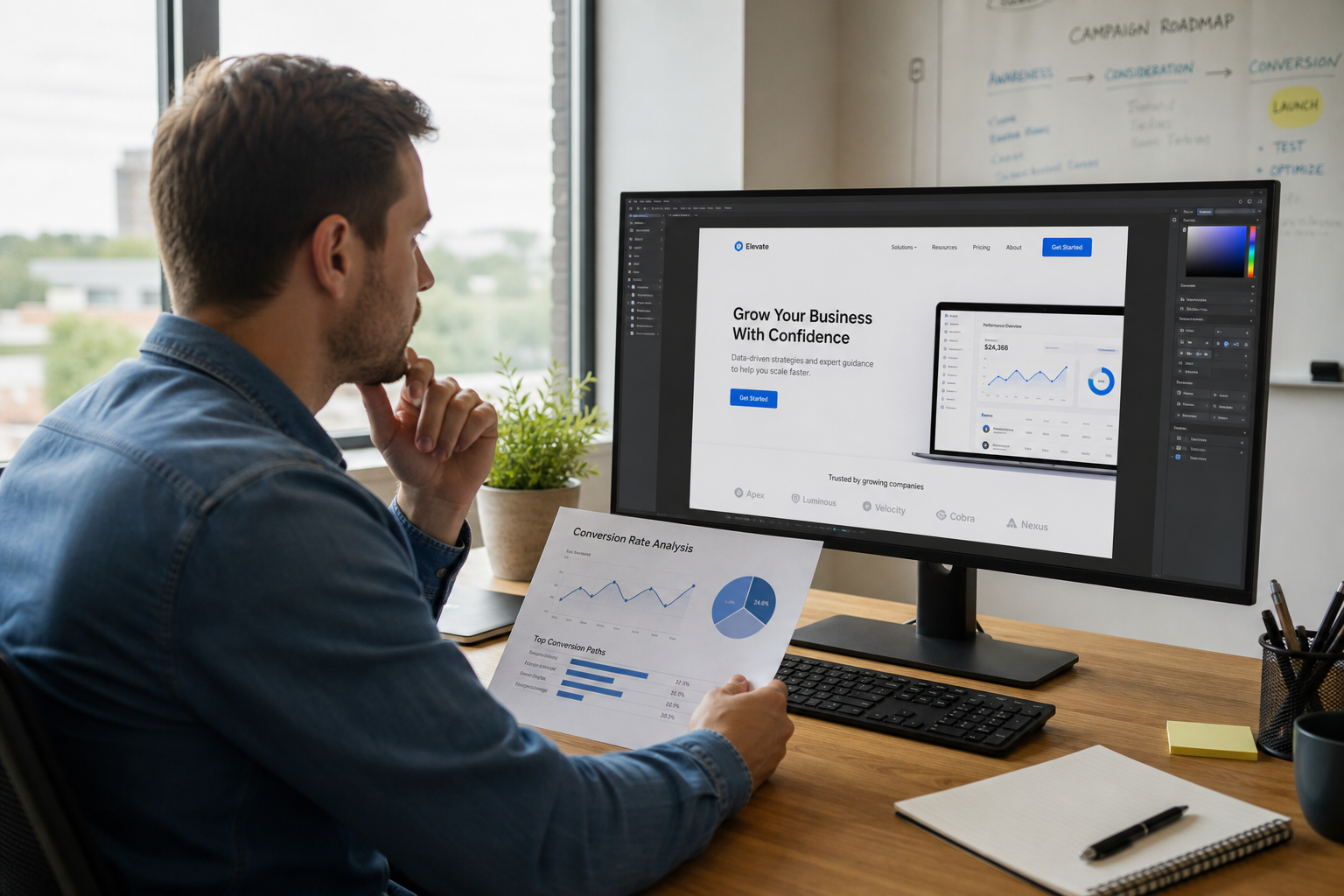
This is the specific reason Alphalead treats design as a growth channel rather than a separate creative purchase: we build the brand identity, the landing pages, and the ad campaigns that run against them in the same shop, on the same lead-tracking dashboard clients already use for cost-per-lead reporting. That means a design change isn't just a subjective "does this look better" call — it's something we can measure against the funnel it actually feeds, the same way we already track cost per lead by industry and landing page performance against a full website. Most design agencies can't make that connection because they don't touch the funnel; most ad agencies can't make it because they don't touch the creative.
Brand Consistency: What It Is and Why It's Worth Protecting
Brand consistency means the same logo, colors, typography, and voice show up the same way everywhere a customer runs into your business — website, ads, packaging, social profiles, even an invoice. It's the difference between a brand that reinforces itself every time someone sees it and one that has to re-earn recognition from scratch each time.
In a survey of 400+ brand management professionals, companies that maintained consistent branding reported revenue gains of up to 33%, up from 23% in an earlier edition of the same survey (Lucidpress/Marq, State of Brand Consistency).6 Worth being direct about what that number is and isn't: it's a self-reported figure from marketing professionals estimating branding's contribution to revenue, not an audited or independently measured causal result. The shift between 23% and 33% across survey editions is itself a sign of real variance, not a fixed constant. Use it as directional evidence that professionals in the field believe consistency pays off — not as a guarantee of a specific return.
Consumers notice inconsistency, too, and it affects trust. In Clutch's November 2025 rebrand research, 98% of consumers said they notice when a familiar brand changes something, and 44% said frequent changes reduce their trust in that brand. Logo updates were the most-noticed change (64%), followed by packaging redesigns (60%), and 80% said brand consistency influences their purchasing decisions (Clutch, rebrand and consumer trust report, Nov 2025).11 The practical takeaway isn't "never change your brand" — it's that changes should be deliberate and infrequent, not the accidental drift that happens when nobody owns the brand system.
DIY Branding vs. Hiring a Professional
Whether DIY branding is fine or a mistake depends entirely on where the business is.
Pre-revenue or just validating an idea: DIY is a reasonable choice. A $10-$100 template-based logo and color palette gets a business looking real enough to start testing demand, without spending money that should go toward finding out if anyone wants what you're selling.
Already running paid ads or investing in a website: this is where DIY branding starts quietly working against you. If you're paying for traffic, every visitor that bounces because the page looks unfinished or the branding feels inconsistent with the ad that brought them there is money spent for nothing. At that point, the cost of a freelance or agency-level brand system is small relative to the ad spend it's protecting — and it's the kind of decision worth pressure-testing against your actual numbers rather than guessing. Alphalead's design and branding work is priced and scoped the same way our media buying is: a flat project cost tied to your stage, not a vague "brand strategy" retainer, and we can show you what a design refresh is likely worth against your current cost-per-lead and conversion numbers before you commit to it.
Growing with an established customer base: this is where brand consistency work — a real style guide, documented voice, templates non-designers on your team can use without drifting off-brand — pays for itself by preventing the small inconsistencies that erode the trust numbers covered above.
There's a middle option worth naming too: a hybrid approach where a professional builds the core system — logo, color palette, typography, a short usage guide — and the business handles day-to-day application itself using that foundation. This sits closer to the freelance end of the cost range and avoids the two failure modes on either side of it: a fully DIY identity with no real system behind it, and an expensive agency engagement a small team can't keep up with once the project wraps.
Branding Mistakes That Quietly Cost Trust
A few patterns show up repeatedly in small business branding, and all of them are avoidable:
- Treating the logo as a finished project. A logo commissioned once and never revisited, with no color system or typography rules behind it, isn't a brand — it's a single asset with nothing to keep it consistent.
- Letting different platforms drift. A different logo crop on Instagram than on the website, or ad creative that doesn't share fonts or colors with the landing page it sends traffic to, breaks the recognition and trust signal covered above.
- Ignoring page performance as a design problem. A beautifully designed page that loads slowly on mobile still loses the visitor — the 123% bounce increase above applies regardless of how good the visuals are.
- Skipping a style guide entirely. Without one, every new hire, freelancer, or platform update becomes a new opportunity for the brand to drift slightly further from itself.
- Rebranding reactively instead of deliberately. Given that 44% of consumers say frequent brand changes reduce trust, a rebrand should solve a real problem, not just relieve founder boredom with the current look.
Where Design Fits Inside a Growth System
The reason branding belongs in the same conversation as lead generation and marketing operations, rather than off in its own aesthetic category, is that it touches every stage of the funnel covered in this guide: the first-impression trust judgment, the mid-funnel checkout or form-fill decision, and the long-term recognition that lowers the cost of every future ad dollar. Most competitors in this space are either design shops with no visibility into whether their work actually converts, or performance-marketing agencies with no design capability at all. Alphalead runs both under one roof and reports both against the same dashboard — which means a brand refresh isn't a leap of faith, it's a measured change against your real lead and conversion numbers. If you're deciding whether your current branding is helping or quietly costing you leads, talk to our team about a design review tied to your actual funnel data, not just a subjective opinion on your logo.
Frequently Asked Questions
Does a logo really matter for a small business?
Yes, though the honest answer is "as part of a consistent system," not "the logo alone." Design was the single most-cited factor in the largest study of website credibility judgments, at 46.1% of participant comments.1 A logo is one visible piece of that larger design impression, not the whole of it. For the peer-reviewed research specifically on logo shape, complexity, and purchase intent, see does a professional logo actually increase sales?.
How much should I budget for branding as a new business?
It depends on your stage. DIY tools run $10-$100 and are reasonable for a pre-revenue business validating an idea. A full freelance branding package runs $2,500-$10,000, and agency work runs $11,000-$70,000 or more, typically once a business has revenue and paid traffic to protect.8,9,10
Is DIY branding ever okay?
Yes — specifically for a business that's still validating demand and hasn't started spending on paid traffic yet. The calculation changes once you're paying for clicks, since inconsistent or unfinished-looking branding then works against the ad spend sending people to it. See DIY branding vs. hiring a designer: a cost-benefit breakdown for what each DIY tool actually gets you, and the trademark risk most comparisons leave out.
What's the actual difference between branding and marketing?
Branding is the identity system — name, logo, colors, voice — that makes a business recognizable and trusted. Marketing is the set of activities that promotes what you sell using that identity. See branding vs. marketing: what's the difference and why businesses confuse them for the full explanation.
Does design quality actually affect how well paid ads convert?
Indirectly but measurably. An ad's design gets someone to click; the landing page's design decides whether that click turns into a lead. If the two don't visually match, or the landing page loads slowly or looks unfinished, the click you paid for is wasted regardless of how strong the ad creative was. See Google Ads vs. Meta Ads by industry for how ad platform choice interacts with the same funnel.
Key Takeaways and Next Steps
Branding isn't a one-time creative purchase — it's a trust signal that gets tested at every stage of a funnel, from the first 50 milliseconds of a page load to the moment someone decides to enter their payment details. The research backs that up consistently, even where individual numbers deserve a caveat. What it should cost has a real answer once you know your stage, and whether to DIY it or hire it out comes down to whether you're already spending money to send people to what your branding represents.
This is the first post in a growing series on branding and design for small business. So far it also includes branding vs. marketing: what's the difference and why businesses confuse them, DIY branding vs. hiring a designer: a cost-benefit breakdown, does a professional logo actually increase sales?, 10 website design elements every small business site needs, rebranding a small business without losing existing customers, brand consistency across Google, social, and your website, how design quality affects ad and landing page conversion rates, and before/after: what a small business website redesign actually changes. Subscribe below to get each new one as it publishes, or get in touch if you'd rather talk through your specific brand and funnel together.
Want more like this in your inbox?
Occasional, practical marketing advice for local service businesses. No spam.
References (11)
- 1.Fogg, B.J. et al. — How do users evaluate the credibility of Web sites?, DUX '03, Stanford Persuasive Technology Lab, n=2,684
- 2.Adobe — 2025 AI and Digital Trends report, Adobe + Oxford Economics, ~7,000 executives/customers, Oct-Nov 2025
- 3.Google / Think with Google — New Industry Benchmarks for Mobile Page Speed, with SOASTA, analysis of 900,000 mobile landing pages, 2017
- 4.Baymard Institute — UX statistics and cart abandonment research, continuously updated, last updated Sep 2025
- 5.Lindgaard, G. et al. — Attention web designers: You have 50 milliseconds to make a good first impression!, Behaviour & Information Technology, 2006
- 6.Lucidpress / Marq — The State of Brand Consistency report, 400+ brand management professionals
- 7.Clutch — No-Code Tools Fuel Website Growth SMB website survey, n=406 US small business owners, Aug 2025
- 8.ManyPixels — How Much Does Logo Design Cost in 2026?
- 9.Fiverr — How Much Does a Logo Design Cost?
- 10.We Are Tenet — Branding Cost Guide
- 11.Clutch — Rebrand and consumer trust report, widely republished via BusinessWire, Nov 2025

Written by
Yash · Creative Specialist
Builds the creative and content that gets your business noticed.