Branding DesignAugust 5, 2026By Yash
Does a Professional Logo Actually Increase Sales?
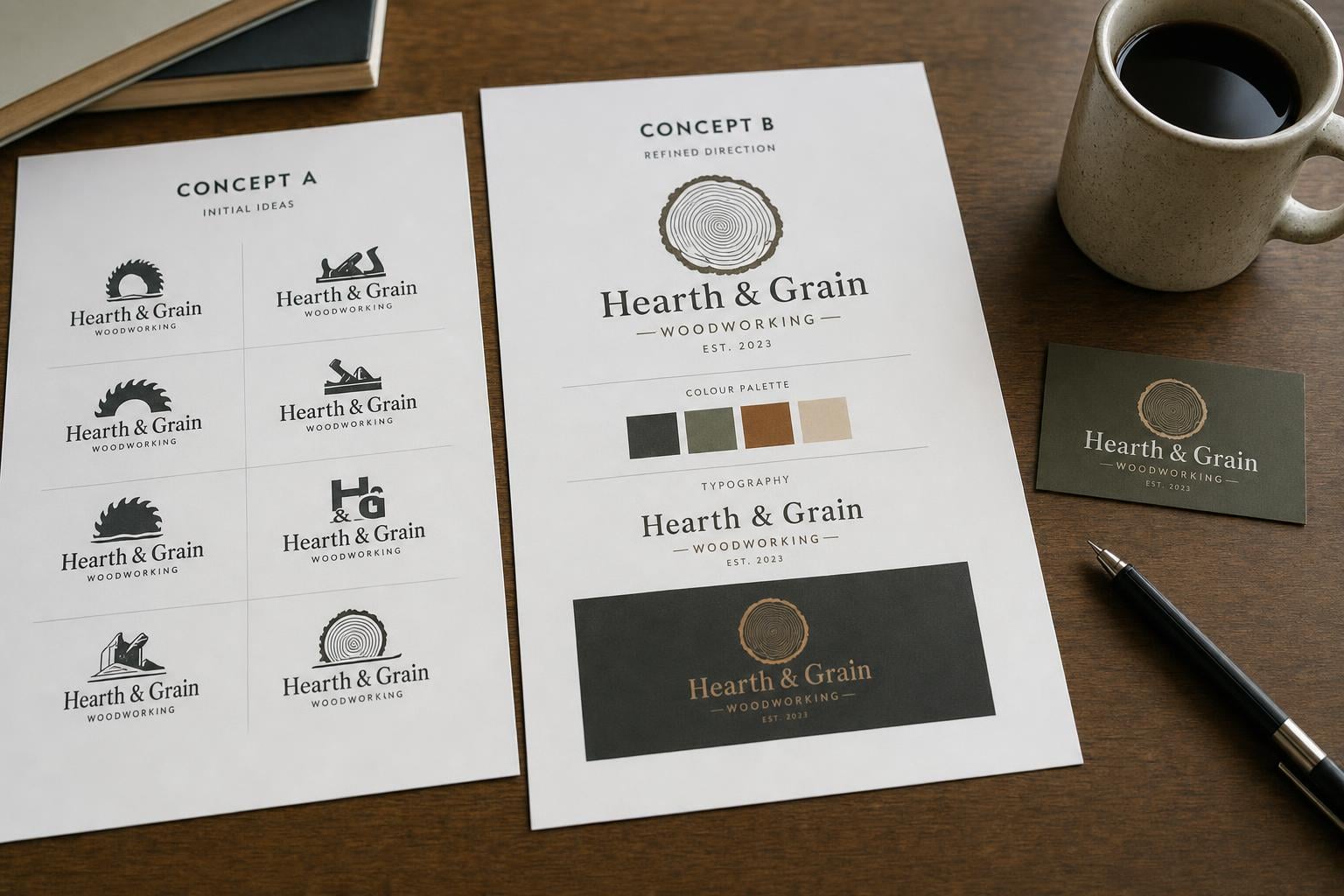
A founder staring at three logo concepts from a designer is really asking one question: will any of this move the needle on sales? It's a fair question. Logo fees run from a $50 template to a $70,000 agency retainer, and the assumption that a more polished logo means more revenue rarely gets checked against real research before the invoice is paid.
The honest answer sits between the two extremes usually offered. Controlled experiments confirm that specific logo attributes, like shape and visual complexity, do change how people judge a brand, but the effect is narrower and more conditional than confident marketing claims suggest. And at least one widely repeated statistic about logo rejection doesn't trace back to any real study at all. This piece works through what the peer-reviewed and survey evidence actually supports, including the parts that complicate a simple "yes" answer.
Key Takeaways
- In a controlled experiment, logo shape alone shifted how people judged a product: circular logos increased perceived comfort and angular logos increased perceived durability, with nothing else about the product changed.1
- Logos designed to signal credibility increase consumer trust and willingness to transact on a website, according to research applying source-credibility theory to logo and site design, though the exact effect size could not be independently confirmed beyond the published abstract.2
- A 2025 study found complex logos significantly increased purchase intention and perceived luxury, directly contradicting the popular claim that simpler logos always perform better.3
- In a survey of 75 CMOs, logo design ranked 6th of 8 priorities when launching a new brand, and mattered less to CMOs at smaller companies than at larger ones, the opposite of the common assumption.4
- No credible study quantifies how many customers reject a "bad" logo; a widely circulated claim that a Harvard Business School study found 66% of consumers reject outdated logos does not trace to any real research and should not be repeated.
In this guide:
- What counts as evidence here
- Does logo shape change how people judge a brand?
- Can a logo make a business seem more trustworthy?
- Simple or complex: which logo style increases purchase intent?
- How much do CMOs actually value logo design?
- What happens when a big brand gets its logo wrong?
- So, does a logo matter for a small business?
- FAQ
What Counts as Evidence Here: Experiments, Surveys, and Case Studies
Not every claim about logos carries equal weight, and mixing up a controlled experiment with a survey or a company anecdote is exactly how a statistic like "66% of consumers reject brands with outdated logos" gets attributed to Harvard Business School and repeated for years. It doesn't trace to any real HBS study, named methodology, or identifiable sample. It appears to have originated in an unsourced roundup post, and it won't appear again in this article.
This piece draws on three kinds of evidence, and each section states which one it's using:
- Controlled experiments: participants randomly assigned to different logo conditions, supporting causal claims about what a logo change actually causes.
- Self-reported surveys: marketing professionals ranking priorities or estimating impact, revealing belief, not proof of a sales outcome.
- Real-world case studies: single companies whose sales moved around a rebrand, illustrative but not generalizable, especially for a multinational with decades of brand equity a small business doesn't share.
Does Logo Shape Change How People Judge a Brand?
Yes, and this is the strongest causal evidence available on logos specifically. Five experiments published in the Journal of Consumer Research tested what happens when the same brand appears with a circular logo, an angular logo, or no logo at all.1 In the primary study, 109 college students were randomly assigned to one of the three conditions and asked to judge product attributes.
The result: logo shape alone, with nothing else about the product changed, shifted how people judged it. Circular logos increased perceived comfort; angular logos increased perceived durability. Researchers traced the effect to visual working memory, meaning the shape triggers an association that colors the judgment that follows. That's a controlled, causal finding: shape isn't decoration, it's doing measurable perceptual work.
The limit is scope. This shows logo shape shifts a specific judgment in a college-student sample, not that a rounder logo increases a small business's sales, or that the effect holds identically across every category and audience.
Can a Logo Make a Business Seem More Trustworthy?
This is where the evidence turns qualitative, and it's the closest legitimate proxy for the popular "bad logo" claim that turns out not to be real. Research applying source-credibility theory, the idea that people judge a message partly by whether its source seems expert and trustworthy, found that logos designed to signal those traits triggered positive credibility judgments about a company's website, increasing both trust and willingness to transact.2 The effect was strongest when the rest of the site's design reinforced the same cues.
Worth noting: the paper is paywalled, and its exact sample size and effect size couldn't be independently confirmed past the abstract. The direction, credibility-signaling logos increase trust, is well supported by the study's framing; treat any specific number attached to it elsewhere with skepticism.
That finding fills a real gap. Rigorous data quantifying how much a "bad" logo penalizes a business is thin. This is the closest legitimate evidence available: a credibility-signaling logo increases trust. The implied inverse, that a generic logo doesn't earn the same boost, is reasonable to infer but wasn't tested as its own number. Trust-building through consistent identity is a branding function specifically, distinct from the promotional work covered in branding vs. marketing: what's the difference and why businesses confuse them.
Simple or Complex: Which Logo Style Increases Purchase Intent?
The popular advice says simpler logos always perform better. A 2025 study in Frontiers in Communication found the opposite in at least one context: complex logos significantly increased purchase intention.3 Across two experiments (n=120 and n=227), complexity increased both purchase intention (B=0.533, p<0.001) and perceived luxury (B=0.519, p<0.001) — in plain terms, a moderately sized, statistically reliable effect on both, unlikely to be due to chance — with luxury perception explaining part of why complexity increased purchase intent.
That's a useful correction to a claim repeated so often it's treated as settled, but it isn't a signal to rush toward more complex logos. Both experiments sampled consumers skewed toward Gen Z and specifically Chinese respondents (63% aged 20-24 in the first), which limits how far the finding generalizes. The honest reading: logo complexity is context-dependent, tied to category and audience, not a universal rule. A premium, luxury positioning may benefit from more visual complexity than one aiming for quick, approachable recognition.
How Much Do CMOs Actually Value Logo Design?
Survey evidence, not causal, but informative about what experienced marketers prioritize. In a February 2019 survey of 75 CMOs at mostly mid-to-large companies (52% over $100 million in revenue), logo design ranked sixth of eight elements when asked what matters most when launching a new brand, well behind naming, positioning, and paid advertising4 — a reminder that identity and promotion are different jobs competing for the same launch budget.
The more interesting detail: logo design was ranked #1 by only 5.6% of CMOs at smaller companies in this sample, versus 12.8% at larger ones, the opposite of the common assumption that logo quality matters most when a business is small and needs credibility fast.4
Two caveats matter. This is a self-reported ranking, not a measured sales outcome. And even the "smaller" companies in this dataset aren't small businesses by any standard definition, 48% sat at or below $100 million in revenue, still enterprise-scale relative to a Small Business Administration definition. Treat this as evidence about corporate marketing priorities, not small-business-specific data.
What Happens When a Big Brand Gets Its Logo Wrong?
Two real-world cases get cited constantly in logo debates, and both need heavier caveats than they usually receive. Neither is small-business evidence; both show that even large-brand identity decisions carry real risk and aren't simple, permanent wins.
When Tropicana redesigned its Pure Premium packaging in January 2009, unit sales fell approximately 20% over the following eight weeks, an estimated $30 million in losses, and the company reverted to its original packaging within about two months.5 The failure was specifically shelf-recognition at the point of purchase: loyal buyers scanning a grocery aisle couldn't spot the product they usually bought. This is a packaging story on a $700 million-per-year product at a multinational, not a generalizable "redesigns hurt sales" rule, and not really about logo quality specifically.
Burberry's 2018 rebrand under Riccardo Tisci, centered on a new monogram, coincided with the stock reaching decade-high levels as the new logo-branded line performed strongly.6 That reads like a success story until 2023, when Burberry reversed course and brought back its earlier knight and horse logo.7 Even a global luxury house with decades of brand equity found a logo change isn't a one-time decision with linear, permanent ROI.
| Source | Sample | Evidence Type | Key Finding |
|---|---|---|---|
| Jiang et al., Journal of Consumer Research (2015) | 109 college students, 5 experiments | Controlled experiment | Logo shape alone shifts perceived comfort (circular) and durability (angular) |
| Lowry et al., Int'l Journal of Human-Computer Interaction (2014) | Not independently confirmed (paywalled) | Experiment, source-credibility framing | Credibility-signaling logos increase trust and willingness to transact |
| Frontiers in Communication (2025) | 120 + 227, skewed Gen Z/Chinese | Controlled experiment, 2 studies | Complex logos increase purchase intent and perceived luxury |
| Lexicon Branding CMO Survey (2019) | 75 CMOs, mostly mid-to-large companies | Self-reported survey | Logo design ranked 6th of 8 brand-launch priorities |
| Tropicana / Ad Age (2009) | Single company case study | Real-world case study | Packaging redesign cut sales ~20% via lost shelf-recognition |
| Burberry / Business of Fashion, The Fashion Law (2018, 2023) | Single company case study | Real-world case study | 2018 monogram rebrand reversed by 2023 |
So, Does a Logo Matter for a Small Business?
Based on the evidence above, a logo is one real input into how people judge a brand, not the deciding factor in whether a business succeeds. Controlled experiments show logo shape and complexity measurably shift perceived comfort, durability, luxury, and purchase intent.1,3 Credibility-signaling logos increase trust and willingness to transact, especially alongside reinforcing site design.2 None of that guarantees anything about your specific business or audience.
What the evidence doesn't support is either extreme: that a logo alone determines whether customers buy, or that logo quality is irrelevant because CMOs ranked it sixth in a survey of companies far larger than most small businesses.4 The Tropicana and Burberry cases show even well-resourced brands treat identity changes as risky, reversible decisions, not one-time wins.
For a small business, the practical read: a logo built with real attention to shape, complexity, and credibility signaling appropriate to your audience is worth doing well, because the underlying mechanisms are real. But it's one piece of a larger trust system, alongside site design, consistency, and load speed, covered in Alphalead's guide to branding as a growth channel. A logo commissioned once and never tested against how customers respond to it is a guess dressed up as a decision.
Frequently Asked Questions
Does a logo actually increase sales?
Controlled experiments show specific attributes, shape and complexity among them, measurably change how people judge a brand, including purchase intent in one 2025 study.3 No study directly measures "logo quality" against sales at a small business, so a logo is one real input into trust and perception, not a standalone sales lever with a proven dollar return.
Should a small business logo be simple or complex?
It depends on category and audience, not a fixed rule. A 2025 study found complex logos increased purchase intention and luxury perception, cutting against the advice that simpler always wins.3 That study skewed toward Gen Z and Chinese consumers, so weigh what fits your specific customers rather than defaulting to either extreme.
Is the claim that "66% of consumers reject brands with outdated logos" true?
No. That statistic, often attributed to a Harvard Business School study of 7,200 participants, doesn't trace to any identifiable real study. It appears to be a fabricated or badly miscited figure that spread through unsourced roundups. Data quantifying a specific "bad logo" penalty is thin; the closest legitimate proxy is research showing credibility-signaling logos increase trust, which implies the reverse but wasn't tested as its own number.2
Is it worth paying for a professional logo as a small business?
Yes, as a reasonable investment where it reflects real attention to shape, complexity, and credibility signaling appropriate to your audience, since those are the attributes shown to shift perception. It shouldn't be treated as a standalone growth lever independent of the rest of a brand's design and consistency; see Alphalead's small business branding guide for the fuller picture, or DIY branding vs. hiring a designer for what each option actually costs and delivers.
Key Takeaways
The research on logos is more honest than most marketing content lets it be: specific, testable attributes like shape and complexity genuinely shift how people judge a brand, credibility-signaling design genuinely increases trust, and the popular claims overstating a single "right" answer, simpler is always better, or a bad logo costs you two-thirds of customers, don't hold up against the primary research. A logo is a real piece of the trust system a small business builds, not the deciding factor, and not something to ignore. The fuller picture, covering website design, load speed, and brand consistency, is in Alphalead's branding for small business guide. To see this same "check the evidence before believing the claim" approach applied to a full site redesign, see before/after: what a small business website redesign actually changes. If you're deciding whether your current logo and brand identity are pulling their weight, talk to a designer about what the evidence above means for your situation.
Want more like this in your inbox?
Occasional, practical marketing advice for local service businesses. No spam.
References (7)
- 1.Jiang, Y., Gorn, G.J., Galli, M., Chattopadhyay, A. — Does Your Company Have the Right Logo? How and Why Circular- and Angular-Logo Shapes Influence Brand Attribute Judgments, Journal of Consumer Research 42(5), 2015, 5 experiments, primary study n=109
- 2.Lowry, P.B., Wilson, D.W., Haig, W.L. — A Picture is Worth a Thousand Words: Source Credibility Theory Applied to Logo and Website Design for Heightened Credibility and Consumer Trust, International Journal of Human-Computer Interaction 30(1), 2014
- 3.Frontiers in Communication — Generational perspectives on logo complexity: influencing luxury perception and purchase intention, 2025, 2 experiments, n=120 and n=227
- 4.Lexicon Branding — CMO Survey, February 2019, n=75 CMOs, mostly mid-to-large companies
- 5.Ad Age — Tropicana Line's Sales Plunge 20% Post-Rebranding, citing Nielsen data, 2009
- 6.The Fashion Law — Burberry's Stock Price Was Higher Today Than It Has Been in a Decade, Thanks to New Logo'ed Products
- 7.Business of Fashion — Burberry Rebrands Under Riccardo Tisci

Written by
Yash · Creative Specialist
Builds the creative and content that gets your business noticed.