
Yes — reviews measurably affect local pack rankings, but not as one signal. Google itself states that more reviews and positive ratings help local ranking, and Whitespark's 2026 survey of local search experts scores five separate review-related signals (rating, quantity, recency, sustained velocity, and sentiment) inside its top 50 local pack ranking factors.1,2 Review count and rating correlate with rank position; they don't fully explain it, and this guide is honest about that distinction where a lot of "reviews matter" content isn't.
Key Takeaways
- Google states directly: "more reviews and positive ratings can help your business's local ranking" — reviews feed the "prominence" factor alongside links.1
- Whitespark's 2026 survey of 47 local search experts scores high numerical ratings as the #6 local pack factor overall (out of 187), ahead of review quantity (#9), recency (#11), and sustained review velocity (#14).2
- Review velocity — a steady trickle of new reviews over time — is scored as a separate, standalone factor from raw review count, not a proxy for it.2
- Owner response presence ranks much lower as an algorithmic factor (#122 of 187) than most advice implies, even though it strongly shapes whether a customer picks up the phone.2
- A widely repeated "88% of consumers trust online reviews as much as personal recommendations" statistic has no traceable primary source — Nielsen's actual Global Trust in Advertising data puts trust in online opinions at 66%, well below the 83% who trust friends and family.6,7
In this guide:
- Does Google actually say reviews affect ranking?
- Every review signal Whitespark's 2026 survey scores, ranked
- Review count and rating: how much, and what the floor looks like
- Review velocity and recency: why a steady trickle beats a one-time push
- Response rate: a weak ranking factor, a strong conversion factor
- Correlation vs. causation: what an independent statistical study adds
- A stat we're rejecting, and why
- What this means in practice
- FAQ
Does Google Actually Say Reviews Affect Ranking?
Most "reviews matter for SEO" posts cite secondary sources for a claim Google has actually made directly. Google's own Business Profile documentation names relevance, distance, and prominence as its three ranking factors, then defines prominence in part by review signals: "this factor's also based on info like how many websites link to your business and how many reviews you have" (Google Business Profile Help, "Tips to improve your local ranking on Google").1 The same page states it plainly: "more reviews and positive ratings can help your business's local ranking."1
Google is just as direct about what doesn't work: "there's no way to request or pay for a better local ranking on Google," and its review policies prohibit offering incentives — discounts, freebies, or anything else — in exchange for reviews.1 Google's separate guidance on managing reviews adds a smaller but relevant point: replying to a review "shows that you value their feedback," which it frames as a trust and differentiation signal rather than a stated ranking multiplier.5
That's the ceiling of what Google says outright: reviews matter and sit inside prominence, but the internal weighting isn't published. Whitespark's annual survey and independent statistical research exist to estimate that gap.
Every Review Signal Whitespark's 2026 Survey Scores, Ranked
Whitespark's 2026 Local Search Ranking Factors survey — 47 local search professionals scoring 187 individual factors, published November 6, 2025 — is the most detailed public estimate of how individual review signals weigh against each other and against everything else in the local pack algorithm.2 Rather than treating "reviews" as one line item, the survey scores 15 separate review-related variables. The table below is every one of them, in rank order.
| Rank (of 187) | Review Signal | Score |
|---|---|---|
| #6 | High numerical Google ratings (4-5 stars) | 181 |
| #9 | Quantity of native Google reviews with text | 170 |
| #11 | Recency of reviews | 164 |
| #14 | Sustained influx of reviews over time | 154 |
| #36 | Keywords appearing in native Google reviews | 117 |
| #38 | Quantity of native Google ratings without text | 116 |
| #42 | Positive sentiment in review text | 112 |
| #43 | Quantity of reviews with photos | 111 |
| #59 | High numerical ratings from authority reviewers | 101 |
| #87 | Quantity of reviews with video | 90 |
| #100 | Quantity of reviews from authority reviewers | 82 |
| #119 | Quantity of third-party (non-Google) traditional reviews | 72 |
| #122 | Presence of owner responses to most reviews | 70 |
| #129 | Keywords in third-party reviews | 67 |
| #159 | Quantity of reactions to reviews | 50 |
Two patterns stand out. First, rating and quantity outrank sentiment and keyword-in-review analysis by a wide margin — Google's own systems appear to weigh the structured signals (star count, text presence) more heavily than parsing what the review actually says. Second, and this surprises most business owners: owner response presence ranks #122, well outside the top tier, meaning the algorithmic ranking benefit of replying to reviews is real but modest compared to the effect on a human reader deciding whether to call.2
Review Count and Rating: How Much, and What the Floor Looks Like
Whitespark's survey shows relative weight; BrightLocal's 2026 Local Consumer Review Survey (1,002 US adults, published February 11, 2026) shows what buyers actually require before a business gets considered at all — the "floor" beneath the ranking-factor score. 97% of consumers read reviews for local businesses, and 41% say they "always" do, up from prior years.3 Two thresholds matter more than the averages: 47% of consumers won't use a business with fewer than 20 reviews, and 31% will only use a business with a 4.5-star average or higher.3 Below either line, a business isn't losing a ranking fraction — it's being filtered out of consideration by a meaningful share of searchers before rank even factors in.
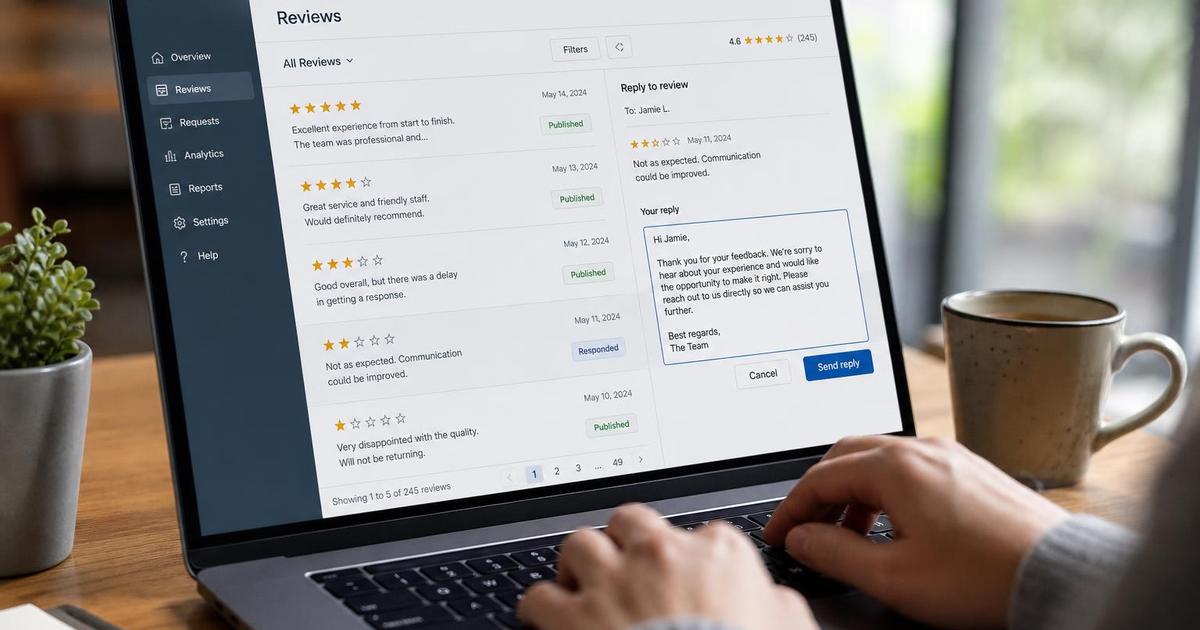
This is where correlation and consumer behavior point the same direction without being the same thing: Whitespark's expert panel scores rating and quantity as top-10 algorithmic factors, and BrightLocal's data shows the same two variables acting as hard cutoffs in human decision-making. A business could theoretically clear the algorithmic bar with fewer than 20 reviews and still lose the click to a competitor with more, for reasons that have nothing to do with Google's ranking system.
Review Velocity and Recency: Why a Steady Trickle Beats a One-Time Push
Whitespark's survey treats "sustained influx of reviews over time" (#14, score 154) as a distinct factor from raw review quantity (#9, score 170) — meaning a business with 80 reviews collected steadily over two years is scored differently than one with 80 reviews from a single push three years ago, even though both show "80" on the profile.2 Recency (#11, score 164) reinforces the same pattern from the ranking side.2
Consumer behavior backs this up independently: 74% of BrightLocal's respondents say they specifically look for reviews written in the last three months, and 32% look for reviews from the last two weeks.3 A profile that stopped collecting reviews after an initial launch push reads as inactive to a large share of buyers, whatever its historical total says.
- Build review requests into a recurring operational step (post-job, post-purchase, post-appointment) rather than a one-time campaign — velocity and recency are scored and perceived separately from total count.
- Don't treat a strong historical count as "done." A profile with 150 reviews and nothing in six months is competing against businesses with fewer total reviews but a visible recent trickle.
- Track review age distribution, not just the average rating — it's the input both the algorithm and the buyer are actually reading.
Response Rate: A Weak Ranking Factor, a Strong Conversion Factor
This is the section most existing "reviews matter" content gets backwards by implication. Owner response presence scores #122 of 187 factors in Whitespark's survey — a real but comparatively minor algorithmic signal, well behind rating, quantity, recency, and velocity.2 Google's own guidance frames responding as a trust and differentiation signal, not a stated ranking multiplier: "when you reply to customer reviews, it shows that you value their feedback. Positive reviews and helpful replies can help your business stand out."5
Where responding earns its weight is in the buyer's decision, not the algorithm's score. BrightLocal's 2026 data shows most consumers now expect a reply at all — expectations have tightened year over year — and a specific, non-templated response reads meaningfully differently to a reader than a generic one.3 The practical implication: treat responding to reviews as a conversion and reputation practice worth doing on its own merits, not primarily as a ranking tactic — because as a ranking tactic, on Whitespark's numbers, it's one of the weaker levers available.

Correlation vs. Causation: What an Independent Statistical Study Adds
Whitespark's data is an expert-opinion survey — valuable, but not the same as directly measuring correlation between a signal and actual ranking position across real search results. Local SEO Guide's ranking factors research, run with statisticians from UC Irvine's Center for Statistical Consulting analyzing local business listings across top-ranking results in numerous US cities, takes the second approach: measuring which variables statistically correlate with higher Map Pack position, rather than surveying opinion.4
Review-related variables consistently rank among the strongest correlating factors in that research. But the study's own authors are explicit about the limit of what that means, and this post holds to the same standard: "an important point as always is that correlation does not equal causation. Nothing in this research will tell you how Google orders local search results."4 A business with strong reviews and a strong rank position doesn't prove reviews caused the rank — both could be downstream of the same thing (a well-run, well-liked, long-established business). Whitespark's survey and Local SEO Guide's statistical work point the same direction independently, which is reasonably strong triangulated evidence — it's just not proof of mechanism, and no source in this space can honestly claim that.
A Stat We're Rejecting, and Why
A version of "88% of consumers trust online reviews as much as personal recommendations" circulates across dozens of marketing blogs, frequently attributed to Nielsen. Tracing it back, the trail runs through secondary aggregator pages to an infographic with no named underlying study, not to any Nielsen report.6
Nielsen's actual Global Trust in Advertising research says something different and less flattering to the claim: 83% of respondents trust recommendations from friends and family, while 66% trust "consumer opinions posted online" — two separate numbers, 17 points apart, not the "as much as" equivalence the circulated stat implies.7 We're naming and rejecting the 88% figure here rather than repeating it, because it doesn't trace to a checkable primary source and the number it's usually attributed to says something else entirely.
What This Means in Practice
Pulling the verified pieces together: reviews affect local rankings through at least five separable signals — rating, quantity, recency, sustained velocity, and (more weakly) response presence — confirmed both by Google's own statement that reviews feed prominence and by Whitespark's factor-by-factor scoring.1,2 Consumer data adds an independent layer: buyers apply their own thresholds (20+ reviews, 4.5+ stars, recency within three months) that filter a business out of consideration regardless of exactly where an algorithm ranks it.3 This isn't a case for chasing reviews for ranking's sake alone — consistent, real review collection serves the algorithm and the buyer's decision at the same time, for overlapping but not identical reasons.
This post is one piece of a broader local visibility picture — see local SEO for small business: the complete guide for the full framework, the Google Business Profile optimization checklist for 2026 for exactly which profile fields to fix first, and what actually moves you into the Google local 3-pack for how review signals sit alongside proximity and relevance in the ranking system overall. For the operational side — request scripts, response templates, and the dispute process for a fake or unfair review — see review and reputation management: a small business playbook. If you want a second pair of eyes on your review data and rankings, get in touch.
Frequently Asked Questions
Do reviews actually affect local SEO rankings?
Yes. Google states directly that more reviews and positive ratings help local ranking, and they're one of the components of "prominence," one of Google's three named local ranking factors.1 Whitespark's 2026 expert survey scores five distinct review-related signals inside the top 50 local pack factors out of 187 measured.2
How many Google reviews do I actually need?
There's no official Google minimum, but consumer data gives a practical floor: 47% of consumers won't use a business with fewer than 20 reviews, and 31% require a 4.5-star average or higher.3 Below either threshold, you risk losing consideration from a meaningful share of searchers independent of your algorithmic rank.
Does replying to reviews improve my ranking?
Only modestly as a direct algorithmic signal — Whitespark's survey ranks owner response presence #122 of 187 factors, well behind rating, quantity, recency, and velocity.2 It matters more as a trust and conversion signal to the human reader deciding whether to contact you, which Google's own guidance frames as the primary benefit.5
Is review count or review rating more important for ranking?
Both are scored highly and separately in Whitespark's 2026 survey — high numerical ratings rank #6 and review quantity with text ranks #9, just two spots apart.2 Treating either alone as sufficient misses the other; both sit near the top of the review-signal group.
Can a business rank well with very few reviews?
It's harder, not impossible — proximity, category accuracy, and other profile factors still carry real weight independent of reviews, per Whitespark's broader factor set.2 But a low review count works against both the algorithmic score and the consumer-behavior floor described above at the same time.
Want more like this in your inbox?
Occasional, practical marketing advice for local service businesses. No spam.
References (7)
- 1.Google Business Profile Help — Tips to improve your local ranking on Google — reviews and prominence, "no way to request or pay for a better local ranking," and incentivized-review policy
- 2.Whitespark — 2026 Local Search Ranking Factors Report, n=47 local search experts scoring 187 factors, published November 6, 2025
- 3.BrightLocal — Local Consumer Review Survey 2026, n=1,002 US adult consumers, SurveyMonkey panel, published February 11, 2026
- 4.Local SEO Guide — Local SEO Ranking Factors Study, statistical correlation analysis with UC Irvine's Center for Statistical Consulting
- 5.Google Business Profile Help — Manage customer reviews — guidance on replying to reviews
- 6.Invesp — The commonly circulated but unsourced origin point for the '88% trust reviews as much as personal recommendations' claim
- 7.Nielsen — Global Trust in Advertising 2015 — actual trust figures (83% friends/family, 66% online consumer opinions) contradicting the circulated 88% stat

Written by
Yash · Creative Specialist
Builds the creative and content that gets your business noticed.