Lead Capture TechnologyAugust 7, 2026By Yash
AI Voice Agents for Small Business: What They Can (and Can't) Automate
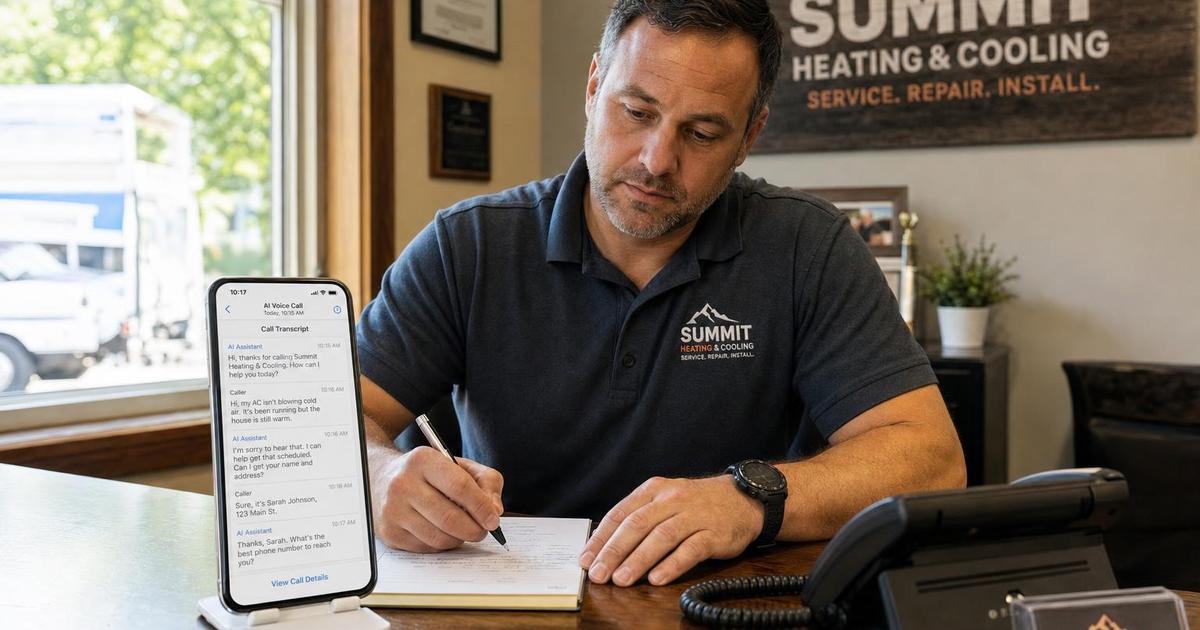
The phone rings while you're on a ladder, mid-job, or asleep. Twenty years ago the choice was voicemail or nothing. Ten years ago it was a phone tree that made people hang up. Now it's an AI voice agent that answers, sounds close enough to a person, and tries to book the appointment before the caller decides to try your competitor instead.
That pitch is everywhere in 2026, and parts of it are genuinely true. But "AI voice agent" gets sold as a single, uniform capability when it's really a spectrum — some tasks it handles about as well as a trained front-desk hire, others it still fumbles in ways that cost you the job. This guide covers both sides honestly: what these systems reliably automate, where a human still needs to take the call, what they actually cost in 2026, and the compliance questions worth asking before you turn one on. If you're comparing this to a text-based alternative, missed-call text-back is the sibling capability worth reading next — same underlying problem, different channel. And if you want the broader case for automating lead follow-up generally, how AI lead follow-up works covers chat and SMS in more depth than this post does.
Key Takeaways
- AI voice agent pricing in 2026 typically runs $0.05-$1.00 per minute depending on the platform, with most managed, CRM-connected options landing around $0.25-$0.50/min, or $30-$200/month per seat for bundled plans.1
- Adoption is real and fast: 88% of organizations now use AI in at least one business function (up from 78% a year earlier), and 62% are at least experimenting with AI agents specifically.2
- Trust hasn't caught up to adoption — 79% of Americans say they strongly prefer a human over an AI agent, and that gap barely narrows across generations.3
- If your AI voice agent places outbound calls (reminders, follow-ups, callbacks), the FCC ruled in February 2024 that AI-generated voices count as "artificial" voices under the TCPA, which means the same consent rules that govern robocalls apply.4
- The clearest win isn't replacing your front desk — it's catching the calls nobody would have answered anyway: after-hours, during a job, or during a rush.
In this guide:
- What counts as an AI voice agent
- What they handle well
- Where a human still needs to take over
- What it actually costs
- Compliance and trust questions to ask first
- How it fits into a bigger system
- FAQ
What Counts as an AI Voice Agent (Not Just a Phone Tree)
An AI voice agent is software that answers or places phone calls and holds a real, back-and-forth spoken conversation — understanding what the caller says and taking an action like booking a slot or logging a message — instead of routing them through a fixed menu of button presses. That's the distinction that matters: a "press 1 for sales" system is a decision tree with prerecorded audio. An AI voice agent uses speech recognition and a language model to follow whatever the caller actually says, including questions the menu designer never anticipated.
Under the hood, most of these systems chain three things together: speech-to-text to transcribe the caller, a language model to decide how to respond, and text-to-speech to say it back — fast enough that the pause doesn't feel like a delay. Some platforms handle all three in one product; others are assembled from separate specialized providers. The market has genuinely matured past the "obviously a robot" stage for short exchanges, which is why adoption has moved fast: McKinsey's 2025 global AI survey of nearly 2,000 organizations across 105 countries found 88% now use AI in at least one business function, up from 78% the year before, and 62% are at least experimenting with AI agents specifically.2
What AI Voice Agents Handle Well
The honest case for an AI voice agent isn't that it's a better salesperson than your best employee. It's that it never lets a call go to voicemail, and a specific, well-defined set of phone tasks turn out to be things it does reliably.
| Task | How well AI voice agents handle it |
|---|---|
| Answering after hours or during a rush | Strong — this is the core use case. The call gets answered instead of dropped, every time, regardless of staffing. |
| Appointment booking against a real calendar | Strong for structured scheduling — checking availability, confirming a slot, sending a reminder — once it's connected to your actual calendar. |
| Basic lead qualification | Solid — asking a fixed set of questions (service needed, location, timeline, budget range) and logging the answers for a human to follow up on. |
| Answering common FAQs | Strong for a defined, stable list — hours, pricing ranges, service area, what's included — anything you could put on a pinned FAQ page. |
| Routing and triage | Solid — recognizing "this is an emergency" versus "this is a general question" and directing the call accordingly. |
Each of these shares a common trait: a defined, mostly predictable shape. The caller wants one of a handful of things, and the agent's job is pattern-matching the request to the right response or action, not improvising a judgment call. That's also why after-hours coverage tends to be where businesses see the clearest return — it's not competing with a human who was going to answer anyway; it's replacing a call that would otherwise have gone to voicemail and, per the surrounding research on missed calls covered in the missed-call text-back guide, often never gets called back at all.

Where a Human Still Needs to Take Over
This is the part vendor pitches tend to gloss over, and it's worth reading carefully before deciding how much of your phone line to hand off.
The trust data is more skeptical than most sales pages let on. SurveyMonkey's December 2025 survey of 2,017 US adults found 79% strongly prefer a human over an AI agent, a majority holding across every generation from Gen Z to Boomers.3 Invoca's Buyer Experience Benchmark survey of 1,000 US and UK consumers found something telling underneath that number: 77% would be more willing to engage with an AI system if they knew there was an easy way to reach a real person, and preference for calling (versus email) has grown 12% since 2022.5 People aren't refusing AI outright — they're refusing to be trapped by it, and they're increasingly calling when they specifically want a conversation.
That preference sharpens once a call gets complicated. Zendesk's own research found 51% of consumers prefer a bot over a human when speed is the priority — but that's conditional on the task being simple.6 The moment a call involves negotiation, an unhappy customer, or a situation the script didn't anticipate, that's still a human's job. A caller negotiating a custom quote or explaining a problem that doesn't fit the agent's expected categories will notice fast if they're talking to a system that can only pattern-match, and pushing them further into that conversation is more likely to lose the job than save it.
Technical limitations compound the gap. Accent and dialect handling remains a real, acknowledged weak point — speech recognition models are still trained predominantly on common accents, so regional or non-native speech increases misrecognition, something AI voice platforms themselves openly acknowledge.7 Background noise does similar damage: a loud shop floor or a customer calling from their car degrades transcription in ways a human listener naturally compensates for. Neither problem is solved yet — it's an active area of improvement, not a finished one.

The practical rule: use the agent for the fast, structured, "let me confirm and get you booked" moments, and build in a fast, obvious way to reach a person the second a call gets emotional, unusual, or high-stakes. That's not a workaround for a weak product — it's the difference between a voice agent that earns trust and one that burns it.
What an AI Voice Agent Actually Costs
Pricing varies more than most buyers expect, because "AI voice agent" spans everything from a bare infrastructure API to a fully managed, CRM-connected phone line. Aircall's 2026 pricing analysis puts the general market range at $0.05 to $1.00 per minute depending on provider type, with bare infrastructure platforms starting around $0.05-$0.15/min before you add your own AI components, and fully managed platforms with built-in CRM integrations typically running $0.25-$0.50/min.1 Beyond per-minute billing, seat-based bundles commonly run $30-$200 per month per seat regardless of usage.1
| Pricing model | Typical range (2026) | Best fit |
|---|---|---|
| Pay-as-you-go, per minute | $0.05-$1.00/min (managed platforms cluster $0.25-$0.50) | Low or unpredictable call volume |
| Monthly seat/bundle plan | $30-$200/month per seat | Predictable, steady call volume |
| Included in a managed marketing/automation plan | Bundled into a broader monthly retainer | Businesses that don't want to manage another separate tool or vendor |
For scale, one widely cited industry cost comparison puts AI-handled minutes around $0.08 each against roughly $7.16 for a comparable human-handled call — a large gap on paper, though it's an average across use cases, not a guarantee for any specific business, and it doesn't account for the value of the calls a human handles better.7 The realistic way to read the pricing landscape: a single-line, low-volume small business can reasonably expect to pay somewhere in the low hundreds of dollars a month for a standalone AI voice tool, while a fully managed setup that's integrated into a broader lead-capture and CRM system will usually cost more up front but require far less of your own time to configure, monitor, and fix when something breaks.
The Compliance and Trust Questions Worth Asking First
Two categories of risk get almost no attention in vendor sales pitches, and both are worth understanding before turning an AI voice agent loose on real calls.
Outbound calling has real regulatory teeth. If your use case is inbound only — the AI answers when a customer calls you — you're on relatively simple ground. The moment it starts placing outbound calls (appointment reminders, missed-call callbacks, review requests by phone), different rules apply. The FCC's February 2024 Declaratory Ruling confirmed AI-generated voices qualify as "artificial" voices under the Telephone Consumer Protection Act, so an outbound AI voice call is treated exactly like a prerecorded robocall for consent purposes — you need the called party's prior express consent, and violations carry real statutory penalties.4 "The AI did it, not a person" is not a defense.
Regulated industries add another layer. Healthcare, legal, and financial services carry additional obligations on top of the TCPA — HIPAA-compliant handling of health information, industry-specific disclosure rules, and stricter recording-consent rules in two-party-consent states. None of this makes an AI voice agent unusable in these industries, but the setup needs more care than a general contractor or salon deploying the same technology.
Disclosure builds the trust the data above says is missing. Opening every call with a brief, honest note that the caller is talking to an automated assistant, plus a fast way to reach a person, directly addresses the 77% of consumers who told Invoca they'd trust an AI system more if reaching a human stayed easy.5
How a Voice Agent Fits Into a Bigger Lead System
An AI voice agent solves one specific problem — the phone gets answered — but it's rarely the whole system on its own. The call still needs to land somewhere: a calendar it can check, a CRM or job board it can log the lead into, and a clear path to a human once the conversation outgrows what the agent can handle. Treated as a bolt-on to an existing setup, it tends to become yet another login and another integration to babysit. Alphalead's lead capture technology guide covers how call answering, text-back, tracking, and CRM syncing work together instead of as separate purchases. If you're weighing AI adoption across the rest of your marketing stack too, AI tools small businesses are actually using in marketing covers writing, image, ad-platform, and SEO tools — it deliberately leaves phone and chat automation to this series rather than covering the same ground twice.
Voice is also just one channel a lead might use. The missed-call text-back guide covers the text-based version of this same after-hours problem, and how AI lead follow-up works makes the broader case across chat and SMS — worth reading if you're deciding which channel to automate first. For a direct head-to-head on cost and coverage, see AI voice agent vs. missed-call text-back vs. human answering service. And once the agent has booked a slot, appointment booking automation covers what happens next to actually get it on the calendar.
Frequently Asked Questions
Can an AI voice agent completely replace a receptionist?
For a single-location, moderate call volume business, it can reliably cover the after-hours and overflow calls a receptionist wasn't handling anyway — but a full replacement is a different bet, since 79% of consumers still strongly prefer a human.3 Most businesses that use one successfully treat it as coverage for calls that would otherwise go unanswered, not a wholesale swap.
Will callers be able to tell they're talking to an AI?
Often, especially once the conversation moves past a scripted question — hesitations, unusual phrasing, or a question the agent wasn't built for tend to reveal it. Leading with a brief, honest disclosure avoids the trust cost of a caller feeling misled if they figure it out mid-call.
Does an AI voice agent handle accents and background noise well?
Not reliably yet. Speech recognition models still show measurable accuracy gaps on non-standard accents and dialects, and background noise degrades transcription in ways a human listener naturally compensates for.7 It's a real, currently-unsolved limitation worth testing against your own customer base before relying on one fully.
Is it legal to use AI to call customers, not just answer their calls?
It depends on inbound versus outbound. Inbound (the AI answers when someone calls you) is straightforward. Outbound AI voice calls — reminders, callbacks, review requests — fall under the same TCPA consent rules as robocalls following the FCC's February 2024 ruling, meaning you need the recipient's prior express consent.4 Regulated industries like healthcare add further requirements on top of that.
How much should a small business expect to pay for an AI voice agent?
Standalone tools generally run $0.05-$1.00 per minute or $30-$200 per month per seat, with fully managed, CRM-connected options clustering around $0.25-$0.50/min.1 A version bundled into a broader managed marketing plan is priced as part of a monthly retainer instead — often a better fit for a business that doesn't want to manage another tool itself.
Key Takeaways and Next Steps
An AI voice agent is genuinely good at one specific job: making sure a call gets answered when nobody otherwise would have picked up. It's not yet a substitute for a person once the conversation gets complicated, and the compliance and trust groundwork matters more than most sales pitches let on. Get the boundary right — automate the structured, predictable calls, hand off the rest fast and visibly — and it's a real capability. Get it wrong, and it just automates the same missed-opportunity problem in a more convincing voice.
This is one of the capabilities we build into a client's plan rather than sell as a standalone tool — our Ultimate plan includes an AI chatbot and voice agent with 24/7 after-hours coverage, set up and managed as part of a broader lead-capture system rather than another login you have to maintain yourself. If you want to see whether it makes sense for how your calls actually come in, talk to a growth strategist.
Want more like this in your inbox?
Occasional, practical marketing advice for local service businesses. No spam.
References (7)
- 1.Aircall — AI Voice Agent Pricing in 2026: Cost Breakdown, Comparisons, and ROI
- 2.McKinsey — The State of AI in 2025: Agents, Innovation, and Transformation, published November 2025, n=1,993 respondents across 105 countries
- 3.SurveyMonkey — Customer service statistics, survey fielded December 10-11, 2025, n=2,017 US adults
- 4.Cooley LLP — Summary of the FCC's February 2024 Declaratory Ruling on AI-generated voices under the TCPA
- 5.Zendesk — 59 AI customer service statistics for 2026
- 6.Invoca — Buyer Experience Benchmark Report survey, July 2025, n=1,000 US and UK consumers
- 7.CloudTalk — AI Voice Agent Statistics 2026 (cost comparison and accent/noise limitation data, citing ElevenLabs, ContactBabel, and McKinsey)

Written by
Yash · Creative Specialist
Builds the creative and content that gets your business noticed.