Lead Capture TechnologyAugust 8, 2026By Yash
AI Voice Agent vs. Missed-Call Text-Back vs. Human Answering Service: Which Fits Your Business
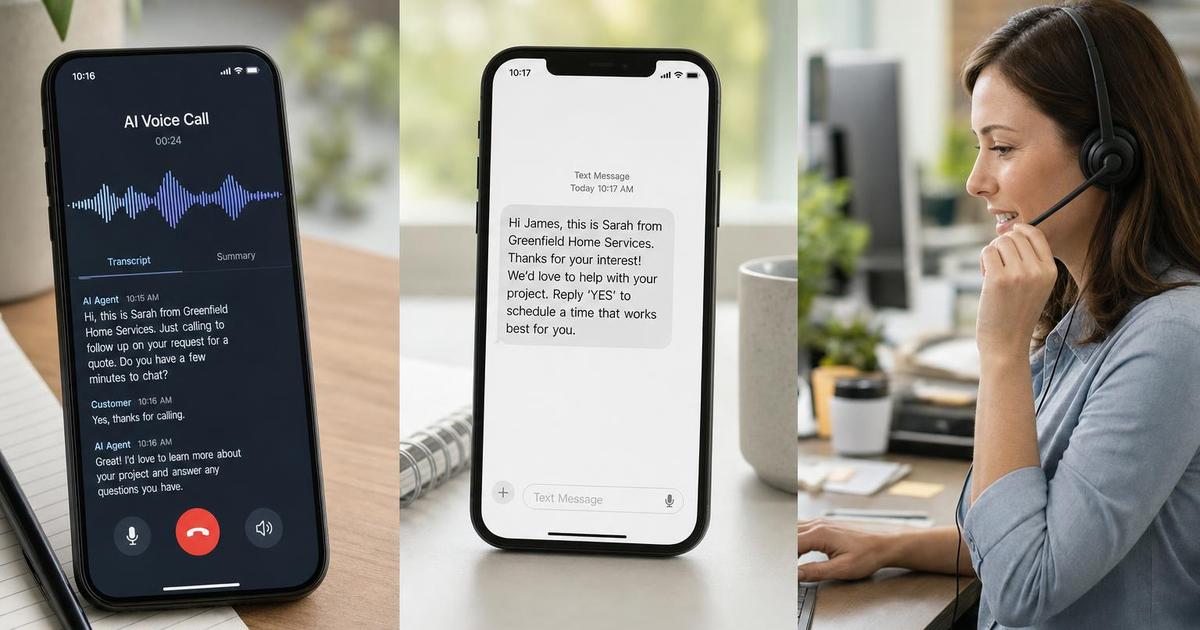
The phone rings, nobody picks up, and you now have three real ways to keep that caller from becoming your competitor's customer instead: an AI voice agent that answers and talks back, an automated text that fires the moment the call goes unanswered, or a human answering service that picks up on your behalf. Vendors selling each option will tell you theirs is the obvious choice. It isn't — the right one depends on your call volume, budget, and how much a caller needs to actually talk something through versus just get a fast acknowledgment.
This guide compares all three honestly: what each one costs, how much coverage it actually gives you, how personal it feels to the caller, and how much setup work it takes — then it makes a specific recommendation for where Alphalead fits into that picture, and where it doesn't.
Key Takeaways
- 62% of calls to small businesses go unanswered in some form — voicemail or no response at all — based on a 30-day study of 85 businesses across 58 industries, and up to 85% of those callers never call back.1,2
- An AI voice agent is the only one of the three that can hold a real spoken conversation and take an action (book a slot, answer a question) without a person involved on either end — pricing runs $0.05-$1.00 per minute, with managed options clustering $0.25-$0.50/min.3
- Missed-call text-back is the fastest and cheapest to stand up, but it's a single message, not a conversation — it catches the caller, it doesn't talk to them.
- A human answering service costs the most on a per-minute basis ($0.75-$1.50/min, $100-$1,000+/month depending on volume) but is the only option that handles a genuinely unpredictable, emotional, or high-stakes call as well as your own front desk would.4
- 79% of Americans say they strongly prefer a human over an AI agent, a preference that holds across every generation — worth weighing against the cost gap before picking the cheapest option by default.5
In this guide:
- What each option actually does
- Side-by-side comparison
- Cost: what you're actually paying for
- Coverage: how much of the gap each one closes
- Personalization: what the caller actually experiences
- Setup complexity: what it actually takes to turn each one on
- Which fits your business
- Where Alphalead fits in
- FAQ
What Each Option Actually Does
These three get lumped together as "answering solutions," but they're not interchangeable — each one solves a different slice of the same problem.
AI voice agent. Software that answers the phone and holds a real back-and-forth spoken conversation — asking what the caller needs, checking a calendar, booking a slot, or logging a message — instead of routing them through a fixed menu. Our full breakdown of what these systems can and can't automate covers the mechanics in depth; the short version here is that it's the only one of the three that talks back.
Missed-call text-back. A narrow, single-trigger automation: a call goes unanswered, an SMS fires to that caller's number within seconds, usually acknowledging the miss and offering a next step like a booking link. It doesn't hold a conversation on its own — the missed-call text-back explainer covers the mechanics and cost in full — it just makes sure the caller hears something back before they give up and dial the next result.
Human answering service. A live person, usually working for a third-party call-answering company rather than your own staff, picks up your business line under your business's name, following a script or set of instructions you provide. It's the oldest of the three options and the one that most closely replicates an actual front desk.
If your leads also come in through a website chat widget rather than a phone line, AI chatbot vs. voice agent covers that adjacent decision — chat, voice, and text-back often end up working together rather than as a single either-or choice.
Side-by-Side Comparison
| Dimension | AI Voice Agent | Missed-Call Text-Back | Human Answering Service |
|---|---|---|---|
| Typical cost | $0.05-$1.00/min; managed options ~$0.25-$0.50/min, or $30-$200/mo per seat3 | Often bundled into VoIP/CRM platforms; standalone setup typically a one-time fee from the tens to low hundreds of dollars | $0.75-$1.50/min or $100-$1,000+/month depending on plan and volume4 |
| Coverage hours | True 24/7 — never sleeps, never gets busy | True 24/7 — fires instantly on any missed call, any hour | Depends on the provider's staffing; many offer 24/7 but at a premium tier, others cover business hours plus overflow only |
| Can hold a real conversation | Yes — understands open-ended speech and can take an action | No — one message, one reply thread, no live back-and-forth | Yes — a real person, same as your own front desk would be |
| Handles complex or emotional calls | Weak — struggles once a call needs judgment or negotiation | Not applicable — it's not built to | Strong — this is what human judgment is actually for |
| Setup effort | Moderate — needs a connected calendar/CRM and script tuning to work well | Low — often a flip-a-switch feature on an existing VoIP/CRM platform | Moderate — needs a detailed script, escalation rules, and a trial period to get right |
| Best-fit business type | Moderate-to-high call volume, structured requests (bookings, FAQs, triage) | Any business that misses calls and wants a fast, cheap first response | Businesses whose calls are frequently complex, high-stakes, or need a genuinely human touch (legal intake, healthcare, high-ticket sales) |
Cost: What You're Actually Paying For
The three options sit on a real cost ladder, and the gap between them isn't small. Missed-call text-back is the cheapest by a wide margin because it's doing the least — it's not paying for a conversation, just a triggered message, which is why it shows up bundled free or near-free inside many VoIP and CRM platforms rather than sold as a standalone premium product.
An AI voice agent costs more because it's doing real work: transcribing speech, generating a response, and speaking it back in real time. Pricing in 2026 typically runs $0.05-$1.00 per minute depending on the platform, with fully managed, CRM-connected options clustering around $0.25-$0.50/min, or $30-$200 per month per seat for bundled plans.3
A human answering service costs the most because you're paying for a person's actual time, not compute. Live per-minute rates typically run $0.75-$1.50/minute, and monthly plans span roughly $100 to $1,000+ depending on call volume and coverage hours — entry-level plans start around $75-$200/month, with high-volume or premium plans pushing past $600.4 One live-answering provider prices around $250/month for 50 minutes, another around $300/month for 30 calls — real examples of how fast the per-minute math adds up.4 Setup fees also tend to run higher, commonly $50-$500 to build out a script and escalation rules.
The honest read: text-back is the cheapest way to stop losing every missed caller outright, an AI voice agent is the mid-cost option that actually talks to people, and a human answering service is the premium option you pay for when the calls themselves are worth that premium.
Coverage: How Much of the Gap Each One Closes
All three can, in principle, run around the clock — but "available 24/7" and "actually closes the gap" aren't the same claim. A missed-call text-back fires the instant a call goes unanswered, any hour, with essentially no marginal cost per trigger, which makes it the most reliably always-on of the three in practice. An AI voice agent is genuinely 24/7 too, and unlike text-back it can actually resolve the call in the moment rather than just acknowledging it — booking the slot right there instead of waiting for a text reply.
A human answering service's 24/7 coverage is a staffing promise, not a software one — it depends on the provider actually having live agents on shift at 2 a.m., which is usually available but commonly priced as a premium tier above standard business-hours coverage. That's worth confirming directly with any provider before assuming round-the-clock coverage is included at the base price.

Personalization: What the Caller Actually Experiences
This is where the trade-offs get real, and it's worth being honest instead of picking a favorite. SurveyMonkey's December 2025 survey of 2,017 US adults found 79% strongly prefer a human over an AI agent, a majority holding across every generation from Gen Z to Boomers.5 That preference doesn't disappear just because a system sounds polished — it sharpens the moment a call gets complicated, emotional, or high-stakes.
A missed-call text-back can feel personal or generic depending entirely on execution — a script that names the business and sounds like it came from a real person performs meaningfully better than a flat template, but it's still a text, not a conversation, and it can't handle anything past the first exchange without a human picking up the thread. An AI voice agent goes further — a real back-and-forth exchange — but callers increasingly notice the moment a question falls outside what the system was built to handle, and the trust data above suggests they'll want an easy way to reach a person once that happens. A human answering service is the closest thing to your own front desk answering, with the caveat that quality still depends heavily on how well the operator was briefed on your business and how closely their script matches how you'd actually talk to a customer.
The practical rule: the more a call is a structured request (book an appointment, confirm your hours, log a message), the less the personalization gap matters. The more a call is unpredictable, emotional, or high-value, the more that 79% number should weigh on which option you pick.
Setup Complexity: What It Actually Takes to Turn Each One On
Missed-call text-back is the lightest lift — on most modern VoIP or cloud-phone systems it's close to a flip-a-switch feature, with the real work being writing a message that doesn't sound like a form letter. An AI voice agent takes real setup: connecting it to an actual calendar, writing and testing a script against real caller phrasing, and deciding where the handoff to a human happens. A human answering service takes comparable front-end work — briefing agents, building escalation rules — plus an ongoing relationship to keep that script current, which is less a one-time task than a standing responsibility.
None of these are projects most owners want to own indefinitely. A text-back script goes stale. A voice agent's calendar integration breaks when you switch scheduling tools. A human answering service's script needs updating every time your hours or pricing change — and somebody has to notice when it hasn't been.
Which Fits Your Business
There's no single right answer here, but the decision usually comes down to two questions: how complex are your calls, and how much are you willing to pay per interaction to handle that complexity well.
If most of your missed calls are simple — "are you open," "can I book a time," "what's your service area" — missed-call text-back or an AI voice agent will cover the large majority of them, and text-back is the cheaper way to start if budget is the binding constraint.
If your calls are usually structured but benefit from a real conversation — a plumber confirming a same-day emergency slot, a salon booking around specific stylist availability — an AI voice agent earns its higher cost by resolving the call instead of just acknowledging it.
If your calls are frequently complex, emotional, or high-stakes — legal intake, healthcare scheduling, high-ticket sales inquiries — a human answering service is worth the premium. No AI system, voice or text, reliably replaces the judgment a caller in a difficult situation is actually looking for.
Many businesses land on a mix rather than a single choice: an AI voice agent or answering service for the calls a system can actually resolve, with text-back catching anything that still slips through unanswered.
Where Alphalead Fits In
To be direct about what we actually offer: Alphalead's Ultimate plan includes an AI voice agent as part of its automation, described exactly as "AI chatbot + voice agent, 24/7 after-hours coverage" — built and managed as part of your account rather than a separate subscription you configure yourself.6 Missed-call text-back is also something we build and manage, wired into the same phone system and CRM view as everything else in a client's lead-capture setup. Both are real, confirmed capabilities we set up and maintain for clients.
We're not going to pretend otherwise about the third option in this comparison: a human answering service isn't something Alphalead currently sells or bundles. If that genuinely fits your business better than the other two — a call pattern heavy on complex, emotional conversations a system shouldn't be handling — that's worth knowing honestly before you buy anything from us or anyone else. What we can tell you accurately is how an AI voice agent or missed-call text-back fits into the rest of a lead-capture system — connected to call tracking, your CRM, and the same team watching your marketing performance, instead of one more login nobody checks. Our lead capture technology guide covers how that fits together.
Frequently Asked Questions
Can I use more than one of these at once?
Yes, and many businesses do — an AI voice agent or human answering service to handle the calls that come through, with missed-call text-back as a fallback for anything that still slips past. They're not mutually exclusive; they cover different failure points in the same problem.
Which option is cheapest to start with?
Missed-call text-back, by a wide margin — it's frequently included in existing VoIP or CRM platforms at little or no extra cost, versus per-minute billing for both AI voice agents and human answering services.
Which option should a legal or healthcare business choose?
Lean toward a human answering service for the calls that carry real stakes — intake calls, urgent scheduling — since the personalization and judgment gap matters most exactly in those situations, per the trust data above.5 An AI voice agent can still be useful for the structured, low-stakes overflow (confirming office hours, basic scheduling) alongside it.
Does an AI voice agent replace a human answering service entirely?
Not reliably for every call type. It handles structured, predictable requests well but still lags on complex or emotional conversations, per our AI voice agent guide. Most businesses use it for the calls it's good at and keep a human path open for the rest.
Key Takeaways and Next Steps
None of these three options is a universal answer — the honest comparison depends on your call volume, how complex your calls actually are, and how much you're willing to pay per interaction to get that complexity handled well. Missed-call text-back is the cheapest safety net, an AI voice agent is the mid-cost option that can actually resolve a structured call, and a human answering service is the premium choice for calls that genuinely need a person's judgment.
If an AI voice agent is the right fit for how your calls come in, that's a capability we build and manage as part of your account rather than sell as a separate tool — talk to a growth strategist about whether it makes sense for your call pattern.
Want more like this in your inbox?
Occasional, practical marketing advice for local service businesses. No spam.
References (6)
- 1.411 Locals — Missed-call study, 30-day monitoring period across 85 businesses in 58 industries
- 2.CallRail — Analysis of 1.1 million real business conversations, cited via Alphalead's lead capture technology guide
- 3.Aircall — AI Voice Agent Pricing in 2026: Cost Breakdown, Comparisons, and ROI
- 4.Nextiva — Answering Service Cost: What You Can Expect to Pay in 2026 — live answering service pricing tiers, per-minute rates, and provider examples, retrieved August 2026
- 5.SurveyMonkey — Customer service statistics, survey fielded December 10-11, 2025, n=2,017 US adults
- 6.Alphalead — Alphalead pricing plan comparison, confirmed directly from the site's PricingComparison component, retrieved August 2026

Written by
Yash · Creative Specialist
Builds the creative and content that gets your business noticed.