Lead Capture TechnologyAugust 7, 2026By Yash
AI Chatbot vs. Voice Agent: Which Channel Should Answer First
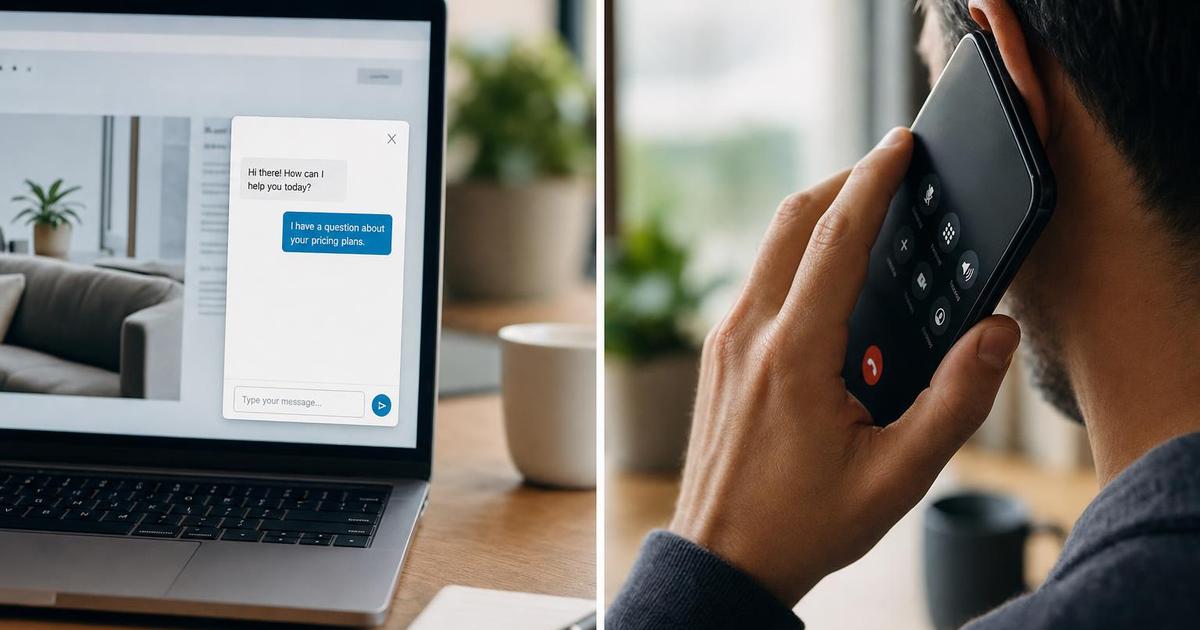
A prospect who wants to talk to your business has three real doors to knock on right now: a chat bubble in the corner of your website, a phone line that either gets answered or doesn't, and a text message if that call goes unanswered. Most small businesses can't build all three well at once, so the real question isn't "which is best" — it's which one to set up first, given how your customers actually reach out.
That's a different question than the one most comparison articles answer. Search "best AI chatbot for small business" and the results are dominated by point-solution vendors ranking their own tool against each other's — Intercom, Drift, Qualified, Tidio. None of them answer the question a business owner is actually holding: whether a text-based chat widget or a phone-based voice agent fits their traffic and call pattern better. This guide answers that directly, on the merits, without pretending one channel strictly beats the other.
Key Takeaways
- Chat and voice solve different moments, not different tiers of the same problem: chat fits someone quietly researching on your website, often after hours; voice fits someone who has already decided to call and wants a real-time answer.
- Phone still wins decisively for urgent and high-value situations — TransUnion's 2024 survey of 1,556 US consumers found people most prefer a phone call for personal matters (64%), high-value decisions (55%), and urgent circumstances (55%), versus 40% for complex decisions.1
- A chat widget installs as a script tag in minutes; a voice agent requires connecting to an actual phone line and calendar, which takes real setup time regardless of provider.
- Standalone AI chatbot platforms typically run $29-$132 per seat per month plus a per-outcome fee, while AI voice agents run $0.05-$1.00 per minute or $30-$200 per seat per month2,3 — neither is free, and both add up as another subscription to manage.
- Most small businesses don't actually have to choose one — the honest answer depends on whether more of your leads currently come from your website or your phone, and the two channels are commonly sold and managed together.
In this guide:
- What each channel actually is
- The real difference: the moment, not the technology
- Typed vs. spoken: what each channel handles well
- Setup friction: what it takes to turn each one on
- What each channel costs
- Who should prioritize which channel first
- You don't actually have to choose
- FAQ
What Each Channel Actually Is
Three distinct capabilities get lumped together under "AI lead capture," and they're not interchangeable:
- An AI chatbot is a widget on your website that answers typed questions in real time — hours, pricing ranges, service area, basic qualification — and can hand off to a person or a booking form when the conversation needs a human.
- An AI voice agent answers or places phone calls and holds an actual spoken conversation, using speech recognition and a language model instead of a fixed phone-tree menu. We've covered what these systems can and can't automate in more depth here.
- Missed-call text-back is neither of the above — it's a narrower automation that fires an SMS the moment an inbound call goes unanswered, catching the caller who already tried the phone and didn't get through. That guide covers the mechanics and cost in detail.
All three exist to close the same broad gap — a real prospect trying to reach you and not getting through — but they intercept that gap at different points, which is why the comparison matters more than a feature checklist would suggest.
The Real Difference Isn't the Technology — It's the Moment
The honest way to compare chat and voice isn't "which AI is smarter." It's asking what your prospect is actually doing in the moment they reach for one channel over the other, because that moment predicts which channel will serve them well.
Chat fits quiet, self-directed research — often outside business hours. Someone on your website at 9pm comparing prices between three contractors isn't ready for a phone call. They want to type a specific question, get a specific answer, and keep browsing without committing to a conversation. A chat widget meets that behavior: low-commitment, and available the moment they land on the page.
Voice fits someone who has already decided to call and wants resolution now. TransUnion's August 2024 survey of 1,556 US consumers found personal matters led phone-call preference at 64%, followed by high-value decisions and urgent circumstances tied at 55%, with complex decisions at 40%.1 Someone calling about a burst pipe or a same-day quote isn't browsing — they've decided the phone is the fastest path to an answer, and they're mid-call, not mid-research.
That's why "which channel is better" is the wrong frame. A visitor typing into a chat widget and a caller with a phone already at their ear are two different people in two different moments — neither channel replaces the behavior the other is built around.

Typed vs. Spoken: What Each Channel Actually Handles Well
Beyond timing, the two channels handle different question shapes well, and pretending otherwise is where a lot of "just add a chatbot" advice falls apart.
Chat handles structured, factual questions cleanly. "What's your service area," "do you install on weekends," "what's a rough price range for X" — these are exactly what a chat widget answers reliably, because the reader can see the answer, copy a link, and keep it as a reference. Chat is also naturally suited to sharing something visual: a price list, a photo, a booking link — none of which translate over a phone call.
Voice handles context and anything needing back-and-forth clarification faster than typing does. Someone describing an unusual problem — "the noise only happens when I turn left, and it started after a pothole" — gets to the point faster talking than typing, and a voice agent can ask a clarifying follow-up in the time a chat widget would need a full extra typed exchange for. Zendesk's 2025 CX Trends report, based on a survey of roughly 10,000 consumers and service leaders across 22 countries, found half of consumers have already engaged with voice AI, and 74% believe an AI system that understands and responds to voice would meaningfully improve their experience.4
Don't judge either channel by whether it can technically handle the other's use case — each is playing against type when it does. The honest comparison is which one matches the question your typical customer is actually asking.
Setup Friction: What It Actually Takes to Turn Each One On
This is the dimension vendor comparison pages tend to skip.
A chat widget is close to the lowest-friction integration on this list — a script tag pasted into your website's header, live within minutes, with no phone infrastructure involved. The work that actually matters — writing the content it answers from, deciding when it hands off to a human — takes longer than the install itself, but the install is trivial.
A voice agent requires real telephony work. It connects to an actual phone line — porting your existing number or routing calls through it — and to a live calendar or CRM if it's booking appointments rather than just taking messages. It's closer to setting up a new phone system than installing a widget.
Missed-call text-back sits in between: it needs the same call-event visibility a voice agent does, but no conversation logic, so it's simpler to configure than a full voice agent.

What Each Channel Actually Costs
Pricing follows the same pattern as the setup friction — chat is generally the cheaper, simpler purchase, and voice costs more because it's doing more.
Intercom, a widely used AI chatbot platform, currently prices Essential at $29/seat/month up to Expert at $132/seat/month, with its Fin AI agent billed separately at $0.99 per resolved conversation.2 Other chatbot platforms cluster in a similar range once a business handles real inquiry volume.
AI voice agents price by usage instead. Aircall's 2026 pricing analysis puts the market range at $0.05-$1.00 per minute, with fully managed, CRM-connected options clustering around $0.25-$0.50/min, or $30-$200/month per seat for bundled plans.3 Low-call-volume businesses land at the low end; higher call volume lands higher.
| Dimension | AI Chat Widget | AI Voice Agent | Missed-Call Text-Back |
|---|---|---|---|
| Best for | Quiet, after-hours website browsing | Someone already mid-call, wanting real-time resolution | Catching a caller who tried the phone and got no answer |
| Question style | Typed, factual, reference-able | Spoken, contextual, needs back-and-forth | A single reply to a short automated text |
| Setup effort | Low — a script tag, live in minutes | Higher — connects to a real phone line and calendar | Moderate — needs call-event visibility, simpler logic than voice |
| Typical cost | ~$29-$132/seat/month + per-outcome fees2 | ~$0.05-$1.00/min or $30-$200/seat/month3 | Often bundled into a phone/CRM platform or a low one-time setup |
| Response immediacy | Instant reply, no wait | Immediate — the call is answered live | Seconds after the missed call, not instant |
Who Should Prioritize Which Channel First
A business whose leads mostly start on the website — quotes, product questions, appointment requests from people browsing after hours — should prioritize chat first. It's the lower-friction install, answering the question your traffic already asks in the format it's already using.
A business that gets more calls than website form fills — trades, home services, anything where customers reach for the phone by habit — should prioritize a voice agent first. Missing those calls is the bigger leak, and it lines up with exactly the kind of business TransUnion's data1 shows leaning on the phone: urgent, personal, high-value work.
A business already fielding calls it can't always answer should treat missed-call text-back as the cheapest, fastest first move regardless of the above — the smallest install, and it directly recovers calls that would otherwise go nowhere.
If you genuinely can't tell which applies to you, pull last month's call log and website form submissions side by side. Whichever volume is higher — and going unanswered more often — is the channel worth setting up first.
You Don't Actually Have to Choose
Everything above assumes a business has to pick one channel and live with the gap on the other side. In practice, most businesses that start with one eventually want both, because the underlying problem — a real prospect trying to reach you and not getting through — shows up on both channels, just at different times and in different formats.
That's the shape Alphalead builds this capability in: our Ultimate plan's feature line reads exactly "AI chatbot + voice agent, 24/7 after-hours coverage" — chat and voice bundled together, not sold as two separate products to research, buy, and connect on your own.

If you're still not sure which channel your business leans on more, that's a reasonable place to start the conversation rather than a blocker — talk to a growth strategist about what your calls and website traffic actually look like, and which mix makes sense for where your leads are really coming from.
Chat and voice are just two pieces of the AI stack a small business runs today — see AI tools small businesses are actually using in marketing for the rest (writing, image generation, ad platforms, review response, and SEO).
Frequently Asked Questions
Should a small business get a chatbot or a voice agent first?
It depends on where more of your leads currently originate. If most inquiries start on your website, especially after hours, a chat widget is the lower-friction, faster win. If most inquiries come in by phone, a voice agent addresses the bigger leak. Checking last month's call log against your website form submissions is the fastest way to answer this for your own business rather than guessing.
Can an AI chatbot handle the same questions as a voice agent?
Not equally well. Chat is strongest on structured, factual questions someone can read and reference — hours, pricing, service area. Voice is stronger on anything with real back-and-forth context, since Zendesk's 2025 research found 74% of consumers believe voice AI that understands and responds to spoken context would meaningfully improve their experience.4 Each can be pushed to handle the other's use case, but it's working against its natural strength when it does.
Is missed-call text-back the same thing as a chatbot?
No. A chatbot holds an open-ended, typed conversation on your website. Missed-call text-back is a single automated SMS triggered only when a phone call goes unanswered — covered in full detail here. They solve overlapping problems through different mechanisms.
How much does it cost to run both a chatbot and a voice agent?
As two separate standalone tools, expect roughly $29-$132/seat/month for the chatbot platform plus per-outcome fees,2 and $0.05-$1.00/minute or $30-$200/seat/month for the voice agent,3 before setup work. Bundled into a managed plan, the cost folds into one monthly retainer instead of two tool bills plus your own time connecting them.
Key Takeaways and Next Steps
Chat and voice aren't competing for the same moment, so the "which is better" framing that dominates most chatbot comparison content misses the actual decision a business owner is facing. Chat wins the quiet, after-hours, typed-question moment. Voice wins the urgent, mid-call, already-decided moment. The right first move is whichever one matches where your leads currently come from and currently go unanswered — and the right long-term move, for most businesses, is having both covered instead of picking a permanent winner.
For the deeper breakdown of each channel individually, see AI voice agents for small business and missed-call text-back, or start from the full lead capture technology guide for how all of these pieces fit together. If you want the phone-specific version of this same decision — voice agent vs. text-back vs. a human answering service — see AI voice agent vs. missed-call text-back vs. human answering service.
Want more like this in your inbox?
Occasional, practical marketing advice for local service businesses. No spam.
References (4)
- 1.TransUnion — Consumer phone channel survey conducted by Toluna, n=1,556 US adults, August 2024, published October 2024
- 2.Intercom — Current published pricing tiers for Intercom's live chat and Fin AI agent, retrieved 2026-08-07
- 3.Aircall — AI Voice Agent Pricing in 2026: Cost Breakdown, Comparisons, and ROI
- 4.Zendesk — 2025 CX Trends Report, survey of consumers and CX leaders/agents/buyers across 22 countries, fielded June-July 2024

Written by
Yash · Creative Specialist
Builds the creative and content that gets your business noticed.