
Search "local SEO for small business" and almost everything that ranks assumes you're in the United States: US directories, US dollar pricing, US-only rules for texting or emailing customers. Most of local SEO — matching your name, address, and phone number everywhere, earning reviews, picking the right Google Business Profile category — works identically whether you're in Calgary or Cleveland. This guide skips that overlap and covers only what's genuinely different for a Canadian small business: which directories actually matter, a real consent law that changes how you can ask for reviews, and what does (and doesn't) differ about Google Business Profile north of the border.
Key Takeaways
- Canada has its own consent law for commercial texts and emails — CASL — with maximum administrative penalties of $1 million CAD per violation for individuals and $10 million CAD per violation for businesses, set by the CRTC.1,2
- CASL's "existing business relationship" exception gives implied consent to email or text past customers for 2 years after their last purchase, but every message still needs a working unsubscribe link and identification of who's sending it.1
- Canadian citation building runs through a different set of directories than the US default: YellowPages.ca, Canada411, and BBB's Canadian regional councils are separate platforms from their US-sounding namesakes, not mirrors of them.3,4,5
- No official Google documentation shows a different local-pack ranking algorithm for Canada — the real Canada-specific factor is that Google Business Profile doesn't auto-translate manually entered fields, which matters for Quebec listings.6
- Local SEO retainers from Canadian agencies typically run $500-$2,500 CAD/month for small businesses, based on market-rate pricing pages rather than a formal industry survey.7,8
In this guide:
- Canadian directories and citations
- CASL: the consent law that changes review requests
- Google Business Profile in Canada
- What local SEO costs in Canada
- What's identical to the US
- FAQ
Canadian Directories and Citations: A Different Set Than the US
Citation building — getting your business's name, address, and phone number listed consistently across directories — is a real local SEO fundamental everywhere. What changes in Canada is which directories are worth the time. A US-focused checklist that tells you to claim Yellowpages.com, Whitepages, or a US Chamber of Commerce listing is sending Canadian businesses to sites that don't serve their market.
The Canadian equivalents are separate businesses, not regional mirrors of the same platform:
| Directory Type | US Default | Canadian Equivalent |
|---|---|---|
| Yellow Pages-style directory | Yellowpages.com | YellowPages.ca (YP.ca), operated by Yellow Pages Limited |
| Phone/address lookup directory | Whitepages.com | Canada411.ca, also operated by Yellow Pages Digital & Media Solutions |
| Accreditation and consumer-trust directory | BBB.org (US councils) | BBB Canadian regional councils (e.g., BBB Central Canada), coordinated by the Council of Better Business Bureaus in Canada |
| General local directory | Various local directory sites | Canpages.ca (its print directory was discontinued years ago; the web listings remain active) |
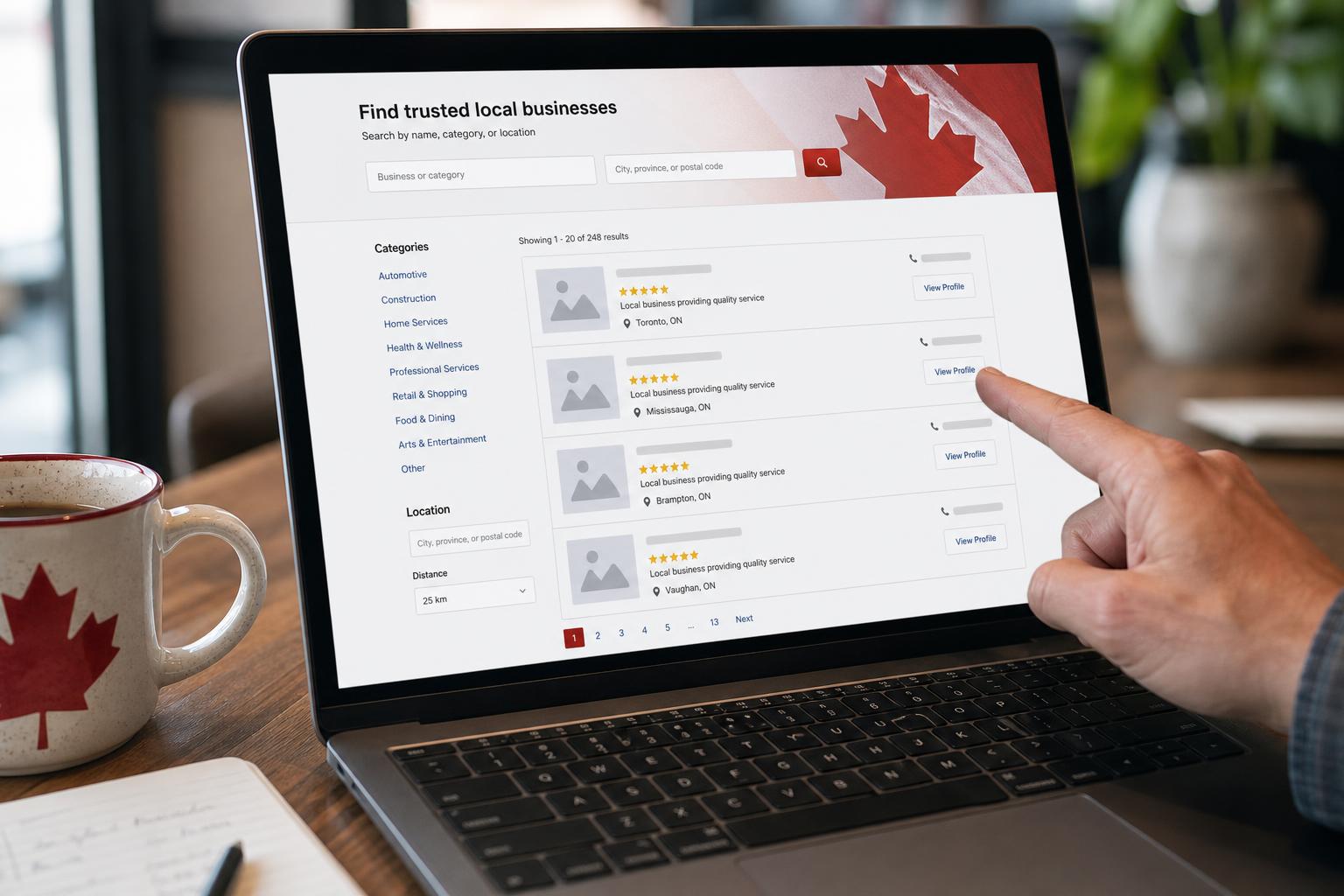
YellowPages.ca and Canada411 are both owned by Yellow Pages Limited, a separate, Toronto-headquartered company from the US Yellow Pages network — a US-side edit or claim doesn't carry over.3,4 BBB accreditation in Canada works through regional Canadian councils rather than one national body, separately recognized from the US BBB structure ISED Canada lists as a consumer-protection resource.5 None of this replaces Google Business Profile as your primary citation — it's additive, the same role US directories play for a US business.
CASL: The Consent Law That Changes How You Can Ask for Reviews
This is the most concrete regulatory difference in this entire guide, and it's a genuine one — not a stretch some blogs make by pattern-matching "regulation" to "must be relevant."
Canada's Anti-Spam Legislation (CASL) governs commercial electronic messages — email and text — sent to promote a product or service, and a review-request message asking a past customer to leave a Google review clears that bar. CASL requires either express consent (the customer opted in) or implied consent under specific conditions, and every message needs an identifiable sender and a working unsubscribe mechanism, regardless of which consent type applies (Canadian Radio-television and Telecommunications Commission, Guidance on Implied Consent).1 The United States has no equivalent — CAN-SPAM sets a lower bar and doesn't require the same opt-in-by-default posture for commercial messages.
The exception that matters most for review requests is the existing business relationship (EBR): if someone bought from you within the last 2 years (or made an inquiry within the last 6 months), you have implied consent to email or text them without needing an explicit opt-in first (CRTC, Guidance on Implied Consent).1 That covers most legitimate review-request campaigns — texting a customer a week after a job to ask for a Google review is squarely inside the EBR window. What it doesn't cover is buying or scraping a list of local phone numbers to blast review requests to people who've never done business with you; that has no consent basis at all under CASL.
Two mechanics apply no matter which consent type you're relying on: you have to respect an opt-out request within 10 business days, and the onus is on you, the sender, to be able to prove you had consent if it's ever challenged — not on the recipient to prove you didn't (CRTC, Guidance on Implied Consent).1 In practice, that means keeping a simple record of when a customer became a customer and when you last messaged them, which most review-request or CRM tools already timestamp automatically.

The penalties are real and set by statute, not blog exaggeration: the maximum administrative monetary penalty is $1 million CAD per violation for an individual and $10 million CAD per violation for a business (CRTC, CASL FAQ).2 Worth being precise about what that figure is: it's the statutory ceiling, not a typical outcome — an actual CRTC enforcement action against an individual sender in 2021 resulted in a $75,000 penalty, well below the maximum.2 A small business running review requests inside the EBR window with a working unsubscribe link isn't the target of CASL enforcement; a business buying cold-contact lists and ignoring opt-outs is. Business Development Bank of Canada's guidance for small businesses corroborates the same EBR window and penalty structure, which is a useful gut-check if the CRTC's own regulatory language reads dense on a first pass.9
Google Business Profile in Canada: What Actually Differs
Here's the honest answer, not a padded one: there's no documented evidence that Google Business Profile or the local 3-pack ranks businesses differently in Canada than in the US. No Google-published source shows different ranking-factor weighting or different proximity behavior by country, and the industry's most-cited ranking factor research — Whitespark's annual Local Search Ranking Factors survey, itself produced by an Edmonton-based company — treats the ranking system as global, not region-specific.6 If you've read a claim that Canadian local search "weighs reviews more" or "favors proximity differently," that's not backed by anything Google or a credible industry survey has published — leave it out of your strategy.
The one real, practical difference is language handling for bilingual and Quebec listings. Google Business Profile automatically translates certain structured fields — categories, hours, attributes — based on a searcher's browser language, but manually written fields like your business description are not auto-translated; they display in whatever language you typed them in, with only the first few hundred characters visible before a searcher has to click "More" (DAC Group, bilingual business listings guide).10 For a business in Quebec — or any market with a meaningfully bilingual customer base — that means deciding which language goes first in your description and manually writing (not machine-translating) the version in the other language, since automated English-to-French translation quality is noticeably less reliable than French-to-English, per the same practitioner guidance.10 This is a UX and content decision, not a ranking algorithm difference, but it's a genuinely Canadian one that a US-focused checklist won't mention because it doesn't apply there.
What Local SEO Actually Costs in Canada
If you're pricing out local SEO help, use CAD figures, not a rough USD conversion. Canadian agency pricing pages converge on a similar range for small business local SEO retainers: roughly $500-$2,500 CAD per month, with project-based work (a citation cleanup or a full GBP audit) running separately from an ongoing retainer.7,8 Worth flagging plainly: this is a market-rate range compiled from agency pricing pages, not a formal, methodology-disclosed industry survey — treat it as a directional planning number, not a benchmark to hold a specific quote against.
What's Identical to the US, and Still Worth Doing Well
Everything not covered above works the same regardless of which side of the border you're on: consistent NAP data everywhere you're listed, the right Google Business Profile primary category, earning and responding to reviews, and location-specific content. Our complete guide to local SEO for small business covers those fundamentals in full, and local SEO vs. national SEO walks through whether local SEO alone is enough for your business. If you also serve customers across the Atlantic, local SEO for small business in the UK covers the equivalent regional differences for that market — a useful comparison for seeing how much of "regional SEO" is really about consent law and directories, not a different Google algorithm.
Frequently Asked Questions
Does CASL really apply to something as small as a review-request text?
Yes. CASL applies to any commercial electronic message — a text or email promoting your business, which includes asking for a review — not just bulk marketing campaigns.1 The good news is the existing business relationship exception makes most legitimate review requests to recent customers straightforward to send without a separate opt-in step, as long as you include a working way to opt out.
Is Canada411 the same as Whitepages?
No. Canada411 is a separate, Canadian-owned directory (operated by Yellow Pages Digital & Media Solutions), not a Canadian version of the US Whitepages.com.4 Treat it as its own citation source to claim and verify, not an automatic sync from a US listing.
Do I need a French version of my Google Business Profile if I'm in Quebec?
Not required by Google, but practically worth doing for structured fields that don't auto-translate, especially your business description. Manually write both language versions rather than relying on machine translation, since automated English-to-French quality is the weaker direction.10
Does ranking in the Canadian local pack work differently than in the US?
Not based on any documented evidence. No Google-published source or credible industry ranking-factor study shows a different algorithm or factor weighting by country.6 Focus on the same fundamentals that work anywhere — NAP consistency, category accuracy, and review volume — and treat the directory and consent differences above as the genuinely Canadian-specific work.
Key Takeaways and Next Steps
Most of local SEO doesn't change at the border — NAP consistency, review generation, and Google Business Profile optimization work the same in Toronto as they do in Tampa. What's genuinely different is narrow but real: CASL sets consent and unsubscribe rules for review-request messages that the US doesn't have, Canadian citation building runs through YellowPages.ca, Canada411, and BBB's Canadian councils rather than their US namesakes, and Quebec listings need manually written French content since Google doesn't auto-translate business descriptions. Get those three right and the rest of your local SEO work carries over from any solid general guide.
This is part of a growing series on local and organic visibility for small business. It also includes our complete local SEO guide and the equivalent regional breakdowns for local SEO in the UK and local SEO in Australia. If you'd rather have someone else handle the Canadian-specific parts of your GBP and citation setup, get in touch and we'll walk through what your business actually needs.
Want more like this in your inbox?
Occasional, practical marketing advice for local service businesses. No spam.
References (10)
- 1.CRTC (Canadian Radio-television and Telecommunications Commission) — Guidance on Implied Consent under Canada's Anti-Spam Legislation
- 2.CRTC — Frequently Asked Questions about CASL, including maximum administrative monetary penalties
- 3.YellowPages.ca / Yellow Pages Limited — Corporate site confirming YP.ca as a distinct Canadian directory
- 4.Canada411 — Active Canadian directory, operated by Yellow Pages Digital & Media Solutions
- 5.Innovation, Science and Economic Development Canada (ISED) — Government listing of Canadian Better Business Bureau councils
- 6.Whitespark — 2026 Local Search Ranking Factors report, 47 local search experts scoring 187 factors
- 7.Clutch — SEO Agency Pricing Guide, August 2026
- 8.Clutch — Top SEO Companies in Canada directory and pricing context
- 9.Business Development Bank of Canada (BDC) — Canada's anti-spam legislation: Your questions answered
- 10.DAC Group — Everything you need to know about bilingual business listings

Written by
Yash · Creative Specialist
Builds the creative and content that gets your business noticed.