Lead Capture TechnologyAugust 8, 2026By Yash
Putting It Together: Reading Your Full Funnel From First Ring to Booked Job

A call comes in. Somebody — or something — answers it. If you're lucky, it turns into a booked job. Ask most owners to walk through what actually happened between those points and you'll get a shrug: they know the call happened, and they know whether the job got booked. Everything in between — where the call came from, whether it happened at 9 p.m. on a Saturday, whether this week's ranking moved at all — lives in three or four different logins nobody has time to check.
That's the real problem this guide is about: not "how do I get more leads," but "how do I actually see what's already happening to the leads I've got" — because you can't manage a funnel you can't see. This is the closing piece of Alphalead's lead-capture technology guide, and it ties the other pieces together: visibility, coverage, and attribution aren't separate projects. They're four stages of one funnel, and they only tell you something useful once you can see them together.
Key Takeaways
- Small businesses with 50 or fewer employees run an average of 36 different software apps, per Okta's 2024 analysis of its own integration network data.1
- Constant app-switching has a measurable cost: a Harvard Business Review study found workers toggle between applications roughly 1,200 times a day, losing close to 4 hours a week — about 9% of work time — reorienting.2
- Only 32% of small businesses use dedicated lead management software, even though 78% rate sales/revenue and 73% rate leads as "very important" metrics, per LocaliQ's 2026 survey of 300+ SMB owners.3
- Up to 85% of callers whose call goes unanswered simply don't call back, per CallRail's analysis of 1.1 million real business conversations — the coverage and attribution stages both have to work, not just one.4
- Alphalead builds call tracking, SEO/GBP rank tracking, and (on Ultimate) AI voice agent coverage into one managed account, connected to the CRM you already use — one place to look instead of four.5
In this guide:
- The four stages of a lead's actual journey
- Stage 1: Visibility decides how many opportunities exist
- Stage 2: Who or what answers the call
- Stage 3: Where the call actually came from
- Stage 4: What happens after the call ends
- Four logins vs. one connected view
- Why seeing it together changes what you do next
- How Alphalead builds this as one account
- FAQ
The Four Stages of a Lead's Actual Journey
Strip away the software and a lead's path through your business is simple: someone finds you, someone (or something) answers, you find out where they came from, and — if everything goes right — the job gets booked. Four stages, each dependent on the one before it actually working.
The trouble is each stage usually lives in a different tool, built by a different vendor, with no reason to talk to each other. Your rank tracker doesn't know your phone rang. Your call log doesn't know why the caller found you. Your calendar doesn't know either happened. The only version of "the funnel" most owners have is the one they reconstruct from memory at the end of a long week — which is another way of saying they don't actually have one.
The rest of this guide walks through each stage in the order a lead actually experiences it, then makes the case for why watching all four in one place turns "I think business is picking up" into "I know exactly which two things I'd fix first."
Stage 1: Visibility Decides How Many Opportunities Exist in the First Place
Before a phone can ring, someone has to find you — and how findable you are is decided largely by whether your Google Business Profile and local rankings are actually being watched, not just set up once and left alone. This stage happens before the funnel even starts, and it's the one owners check least, because a ranking drop doesn't announce itself the way a missed call does. It just shows up later as a quieter month.
Local SEO and GBP rank tracking covers exactly which signals are worth watching weekly and why a single "are we #1" check misses most of what's moving. The short version: visibility isn't a one-time project, it changes week to week, and a business that isn't watching it can't tell whether a slower month is a ranking problem, a seasonal dip, or something else — three different fixes that look identical from the outside if all you have is "the phone didn't ring as much."

Stage 2: Who or What Answers the Call
Once someone finds you and dials, what happens next depends entirely on when they called. During business hours, a real person picks up — that part doesn't need new technology. But calls don't stop when your team goes home, and a call that rings out after hours is functionally the same as a call that never happened, except worse: the caller already tried you and got nothing, so their next move is usually to call the next result on the list.
This is the coverage question, and it's the piece what happens to a lead after hours covers with the actual data on off-hours response. For a funnel view, the point is narrower: whether a call gets answered by a person, an AI voice agent, or nobody is a distinct data point from whether the call happened at all — and if your dashboard can't show that "answered" versus "rang out" split, you can't tell whether after-hours coverage is doing its job or quietly leaking calls the same as if it didn't exist.
Alphalead's Ultimate plan includes an AI voice agent bundled with 24/7 after-hours coverage, described in the plan comparison as "AI chatbot + voice agent, 24/7 after-hours coverage" — built to pick up exactly the calls that would otherwise ring out once the office closes.5
Stage 3: Where the Call Actually Came From
A call that gets answered is only half the picture. The other half is knowing which campaign, listing, or search result actually produced it — without that, you can't tell your best-performing channel from your worst one, you're just guessing based on gut feel and whichever campaign you boosted last month.
Call tracking explained covers this in full, but the core idea is simple: a distinct tracked number per channel means every call arrives with its source already attached, independent of whether the caller's browser allowed a tracking cookie. That matters more now than it used to — phone leads convert to revenue at a meaningfully higher rate than web-form leads, so a channel producing quiet, untracked calls could easily be your best one and you'd have no way to know it.6 Without call tracking, that call is answered, maybe even booked, and still invisible in every report that only counts clicks and form fills.
Stage 4: What Happens After the Call Ends
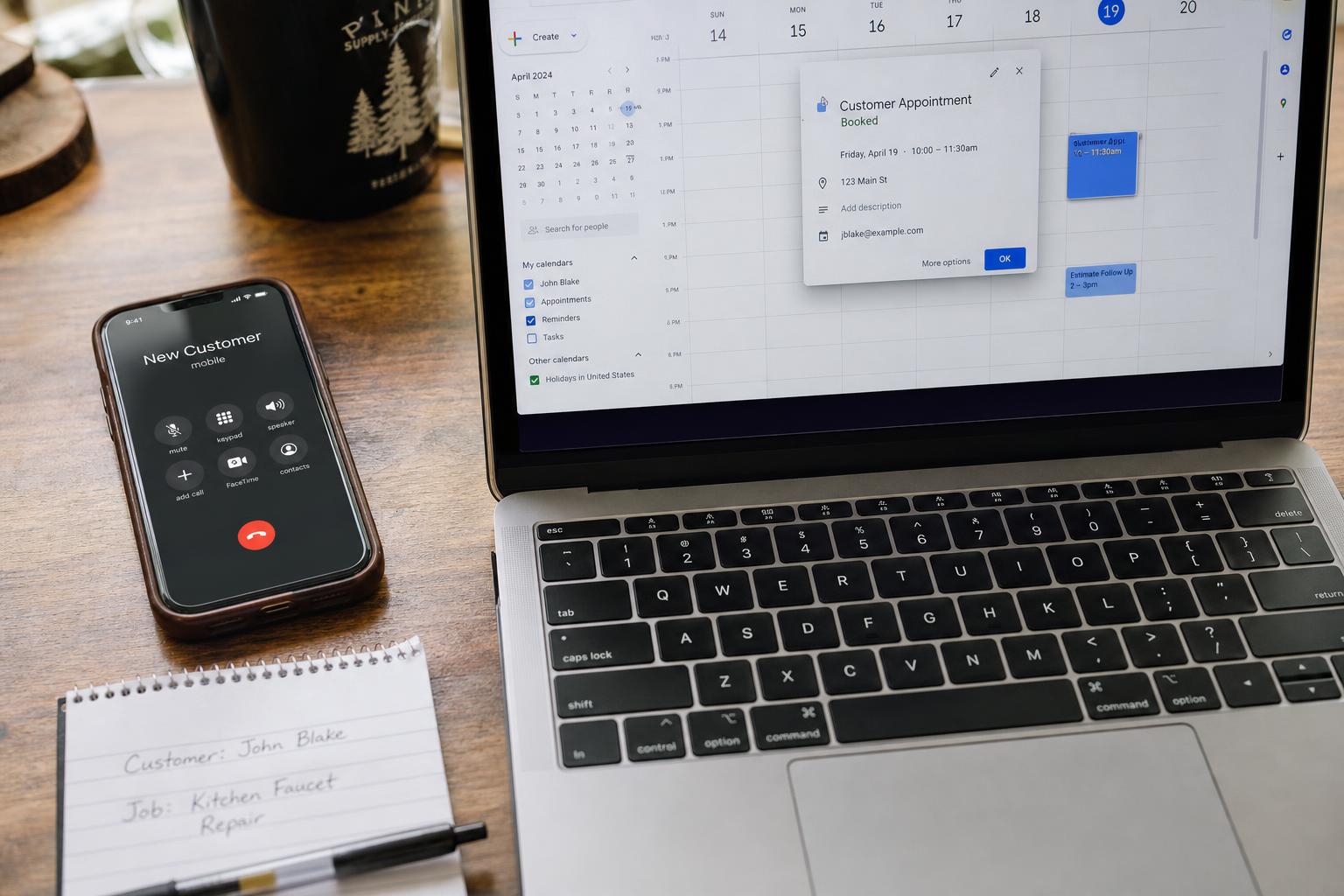
The call ends, and now the lead needs to land somewhere your team actually works from — not a sticky note, not someone's memory of "I think that was the Elm Street job." This is where CRM integration does its quiet work: Alphalead doesn't sell its own CRM, it connects to whatever job scheduling or CRM system you already use, so a call answered by your team or the voice agent ends up as a record in the system your team already checks, not a fifth login nobody remembers to open.
Getting a lead onto the calendar itself — the literal booking step — is its own automation question, and appointment booking automation covers what that looks like today. For the funnel view, the point is simple: a lead's journey doesn't end at "answered," it ends at "booked" — and the stretch between those two points is exactly where a disconnected system quietly loses leads that everything upstream did correctly.
Four Logins vs. One Connected View
Laid side by side, checking four separate tools versus watching one connected account is the difference between reconstructing your funnel from memory and actually seeing it.
| What you're trying to know | Four separate logins | One connected view |
|---|---|---|
| Are we visible enough to be found? | Rank tracker, checked whenever someone remembers | Weekly (or bi-weekly) ranking data alongside everything else |
| Are calls getting answered? | Phone system's own call log, if it has one | Answered/missed split visible next to source and outcome |
| Which channel actually produced this call? | Guessed from campaign timing, or not known at all | Attached to every call automatically via a tracked number |
| Did this lead turn into a job? | Cross-referenced manually against a separate calendar/CRM | Connected to the CRM or scheduling tool you already use |
| What changed this month vs. last month? | A guess, reconstructed from memory across four tools | One trend, visible across all four stages together |
None of the four tools on the left are doing anything wrong on their own — a rank tracker tracks rankings, a call log logs calls. The problem is structural: each one only knows its own slice, and nobody's job is to sit at the intersection of all four and notice the pattern.
Why Seeing It Together Changes What You Do Next
This isn't a small inconvenience. Small businesses with 50 or fewer employees already run an average of 36 different software apps, per Okta's 2024 analysis of its own integration platform.1 Every additional login is one more place a real signal can get missed, not because the tool failed, but because nobody had time to open it that week — and the cost is measurable: Harvard Business Review found workers switch between applications roughly 1,200 times a day, losing close to 4 hours a week just reorienting.2 An owner checking a rank tracker, a call log, and a calendar separately pays that same tax, on top of the time spent actually looking at each one.
The gap isn't abstract, either. LocaliQ's 2026 survey of over 300 small business owners found that while 78% rate sales/revenue and 73% rate leads as "very important" metrics, only 32% use dedicated lead management software to track them.3 Most owners already know leads and revenue are the numbers that matter — most just don't have a system built to show them together.
When visibility, coverage, and attribution live in one place, the questions get sharper. Instead of "did marketing work this month," you can ask "did the ranking drop, did more calls go unanswered, or did an answered channel just stop converting" — three different fixes, and you can only tell them apart if you can see all three stages at once.
How Alphalead Builds This as One Account
Alphalead doesn't sell rank tracking, call tracking, and voice-agent coverage as three separate subscriptions with three separate logins — they're built into one managed account, scaled by plan:
- SEO and GBP rank tracking runs monthly on Starter, bi-weekly on Growth, and weekly with competitor tracking on Ultimate — the visibility stage, watched on a cadence that matches how much is riding on it.5
- Call tracking is part of Growth's automation ("email, SMS & call tracking"), and Ultimate bundles it directly with weekly GBP tracking — the same team watching your rankings watches your call source too.5
- AI voice agent coverage is included on Ultimate as "AI chatbot + voice agent, 24/7 after-hours coverage" — answering what your team can't, nights and weekends.5
- CRM integration connects to the job scheduling or CRM software you already run your business on, so leads land where your team already looks.
None of that requires you to become the person who checks four dashboards every week. It's built and monitored as one account, by a team already looking at all four stages together — the funnel was always four stages, the only thing that changes is whether you can actually see them.
Frequently Asked Questions
What's the difference between a lead-tracking dashboard and a CRM?
A CRM stores and manages your contacts and jobs. A lead-tracking dashboard shows the stages before that — visibility, whether calls get answered, and which channel produced them. The two work together: attribution and coverage data feed into the CRM you already use, rather than replacing it.
Do I need all four capabilities, or can I start with one?
Most businesses start with whichever stage is the biggest question mark — often call tracking, since "which channel is actually working" is the question owners ask most. Rank tracking and after-hours coverage tend to matter more once call volume is high enough that a missed call or a ranking dip has a real dollar cost attached.
Does this replace my existing CRM or scheduling software?
No. Alphalead doesn't sell a proprietary CRM — it connects to the one you already use, so tracked calls and lead source data land in the system your team already works from.
How long before a connected view shows a useful pattern?
Attribution and coverage data are useful from day one — every call gets a source and an answered/missed outcome immediately. Trend-level insight, like whether a ranking dip is costing you calls, takes a few weeks of real data to separate signal from normal week-to-week noise.
Key Takeaways and Next Steps
A lead's real journey has four stages — found, answered, attributed, booked — and most small businesses can only see one or two at a time, in tools that were never built to talk to each other. That's not a discipline problem you fix by checking more logins; it's a structural gap, and it's why "I think business is picking up" is usually the most precise answer an owner can give about their own funnel.
This is what we build as one connected account rather than four separate purchases: rank tracking, call tracking, AI voice agent coverage, and a connection to the CRM or scheduling tool you already use — watched by the same team, reported in the same place. If you want to see what your own funnel would actually show once it's in one view, talk to a growth strategist.
Want more like this in your inbox?
Occasional, practical marketing advice for local service businesses. No spam.
References (6)
- 1.Okta — SMBs at Work 2024: What apps make the SMB stack? Small businesses with 50 or fewer employees deploy around 36 apps on average; all SMBs average 58, published August 2024
- 2.Harvard Business Review — How Much Time and Energy Do We Waste Toggling Between Applications? Study of 137 employees across three Fortune 500 companies, published August 29, 2022
- 3.LocaliQ — The Big Small Business Marketing Trends Report for 2026, survey of 300+ small business owners; 78% rate sales/revenue and 73% rate leads as very important metrics, only 32% use dedicated lead management software
- 4.CallRail — From Conversations to Conversions: How Small Businesses Can Market Smarter, analysis of 1.1 million de-identified conversations across 7 industries; up to 85% of callers whose call goes unanswered do not call back, January 2025
- 5.Alphalead — Alphalead pricing plan comparison, confirmed directly from the site's PricingComparison component, retrieved August 2026
- 6.Invoca — Digital marketing statistics roundup citing BIA/Kelsey research that phone leads convert to revenue 10-15x more often than web-form leads

Written by
Yash · Creative Specialist
Builds the creative and content that gets your business noticed.