Lead Capture TechnologyAugust 7, 2026By Yash
Local SEO and GBP Rank Tracking: What to Actually Watch Weekly

Ask most small business owners how their local rankings are doing and you get one of two answers: "I have no idea," or "I checked yesterday and we're #1" — for a keyword that isn't the one bringing in calls. Both answers point to the same underlying problem: nobody's watching the numbers that actually move, and the ones that do get checked usually aren't the ones that matter.
This isn't a roundup of rank-tracking tools. BrightLocal, Whitespark, and a handful of other established platforms already do that job well, and a vendor comparison wouldn't add anything a review site hasn't already covered. This is about the four signals worth watching week to week, why each one matters more than a single "are we #1" snapshot, and what having that tracked and reported for you actually looks like in practice.
Key Takeaways
- Local-pack position and organic blue-link rank are increasingly separate signals, not the same ranking — Google's August 2024 "Diversity Update" measurably decoupled the two.1
- Whitespark's 2026 survey of 47 local search experts ranks Google Business Profile signals as the single largest local-pack ranking factor category, with review signals second.2
- Review recency matters more than raw star rating — a documented case study found local-pack rankings tracked directly with whether a business was actively generating new reviews, rising and falling with the activity.3
- 84% of consumers now use Google as their primary source for business reviews, up from 81% a year earlier — reviews aren't a side signal, they're the default trust check.4
- Only 64% of local businesses have even verified their Google Business Profile, per Birdeye's dataset of 150,000+ listings — a lot of "competitor movement" is really just competitors starting to pay attention.5
In this guide:
- The four signals worth checking weekly
- GBP visibility for the queries that actually drive calls
- Review velocity, not just star rating
- Local-pack position by keyword, separate from organic rank
- Competitor movement inside your local pack
- Why most small businesses aren't watching any of this
- Having this tracked and reported for you instead
- FAQ
The Four Signals Worth Checking Weekly
Most owners who do check their rankings check one thing: typing their business name or main service into Google and seeing where they land. That's the least useful version of rank tracking available, because it's usually personalized by your search history and location, and it tells you nothing about the specific queries a stranger three miles away is actually typing.
The four signals below are what actually correlate with whether the phone rings, based on how the local algorithm is understood to work and how review behavior is documented to influence it.
| Signal | What it actually tells you | Why "am I #1" doesn't |
|---|---|---|
| GBP visibility for target queries | Whether you show up in the map pack for the specific services people search for, not your brand name | Brand-name searches are usually already won; they don't reflect new-customer discovery |
| Review velocity | Whether new reviews are still coming in, and how fast, not just your current star average | A 4.8 rating with no reviews in three months reads as stale to both customers and the algorithm |
| Local-pack position by keyword | Map-pack rank specifically, which runs on a partly separate track from organic blue-link rank | Organic rank can climb while map-pack position drops, or vice versa |
| Competitor movement | Who's gaining or losing ground in the same pack, and roughly why | A static snapshot of your own listing tells you nothing about whether the pack is quietly changing shape around you |
GBP Visibility for the Queries That Actually Drive Calls
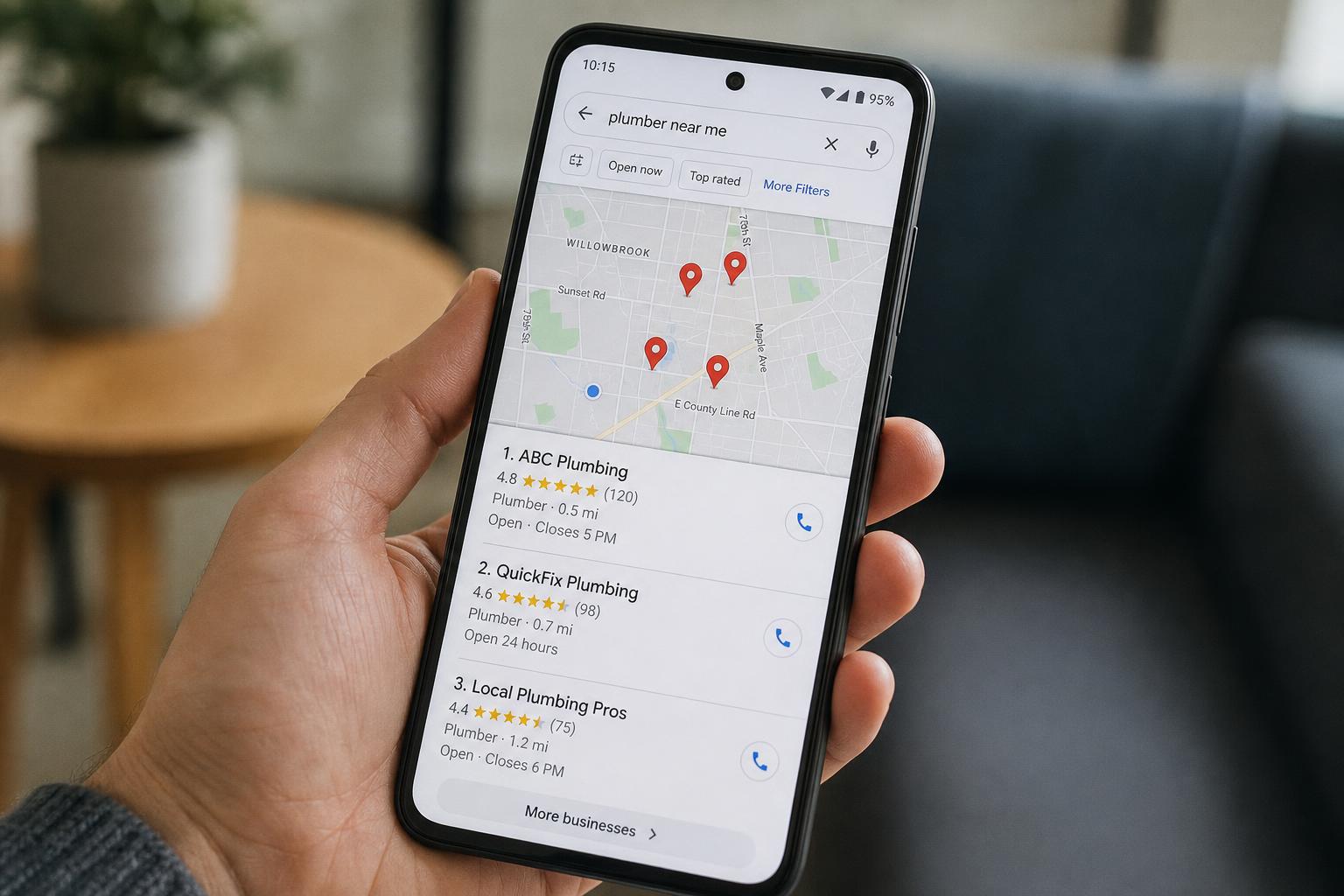
The question worth tracking weekly isn't "where do I rank" — it's "where do I rank for the handful of searches that actually turn into calls." A plumber ranking #1 for their own business name and #9 for "emergency plumber [city]" is not doing well, even though a quick self-check would look reassuring.
Whitespark's 2026 Local Search Ranking Factors survey, which polled 47 local search practitioners on 187 individual factors, found Google Business Profile signals make up the single largest category of what determines local-pack rank, with review signals ranking second.2 That ordering matters for where attention should go: a GBP that's fully filled out, categorized correctly, and actively maintained is doing more ranking work than most of the on-page SEO tactics that get far more attention from business owners.
Tracking this weekly means checking map-pack visibility for the 5-10 service-and-location combinations that actually represent real customer searches — "roof repair [city]," "same-day AC repair [neighborhood]" — not the business's own name, and not a single generic head term the owner happens to think of first.
Review Velocity, Not Just Star Rating
A star rating is a snapshot. Velocity — how many new reviews are coming in and how recently — is closer to a live signal, and it behaves differently than most owners assume.
Whitespark's Darren Shaw has argued review recency deserves top-five importance among all local ranking factors, pointing to a documented case study from Sterling Sky: a business's local-pack rankings rose while it was actively running a review-request program, fell when the program stopped, and rebounded once it started again.3 That's not a controlled statistical study, but it's a traceable, named example of rankings moving in step with review activity rather than review count alone.
Consumer behavior backs up why this matters beyond the algorithm. BrightLocal's Local Consumer Review Survey 2025, based on 1,026 US adults, found 84% now use Google as their primary source for business reviews, up from 81% the year before — and only 4% say they never read reviews at all.4 The same research found rising tolerance for lower review counts, which is a subtle but important shift: a thin but recent set of reviews increasingly reads as more credible than a large, stagnant pile of reviews from two years ago.
Tracking review velocity weekly is straightforward in principle: count of new reviews since the last check, average rating trend, and response rate to new reviews (unanswered reviews, especially negative ones, sit there as a visible signal to every future customer who reads them).

Local-Pack Position by Keyword, Separate From Organic Rank
It's tempting to treat "rank" as one number, but local-pack position and organic blue-link position increasingly move on separate tracks. Google's August 2024 "Diversity Update," documented in detail by local SEO firm Sterling Sky, demotes a business's organic listing for a URL when that same URL is already winning the local pack for the same query — direct evidence that the two are more algorithmically decoupled than they used to be.1 A business can gain local-pack ground while its organic ranking for the identical search term moves in the opposite direction, and a rank tracker that only reports one number hides that entirely.
This is also where "near me" behavior matters. Google's own consumer research found searches for "[X] near me now" grew more than 150% over a two-year period — a durable shift in how local intent gets typed into the search bar, not a passing trend.6 Those queries resolve almost entirely into the map pack, not the organic results below it, which is another reason watching organic rank alone misses where the actual local competition is happening.
Tracking this weekly means checking map-pack position specifically, keyword by keyword, for the queries identified in the first section — not a single blended "visibility score" that mixes organic and map-pack signals into one number that's hard to act on.
Competitor Movement Inside Your Local Pack
A business's own listing, watched in isolation, only tells half the story. The other half is what's happening around it — whether a competitor two blocks over just picked up eight new reviews in a month, started posting weekly GBP updates, or fixed a category mismatch that had been quietly capping their visibility.
This is where the "who's watching this" gap actually shows up. Birdeye's State of Google Business Profile report, built from a dataset of over 150,000 local business listings, found only 64% of businesses have even verified their GBP listing, and the average verified profile has fewer than one photo.5 Read against the ranking-factor research above, that's a meaningful gap: if GBP completeness and activity are the top two ranking factor categories, and most competitors aren't even doing the basics, then a modest, consistent effort is often enough to move ahead of a real chunk of the local pack — and the reverse is just as true. A competitor's sudden climb frequently isn't a mystery algorithm shift; it's them finally doing what should have been happening all along.
Weekly competitor tracking means watching pack position for the same competitors across the same target keywords, plus a lighter check on visible review count and posting activity — not a one-time competitive audit that goes stale the moment it's finished.
Why Most Small Businesses Aren't Watching Any of This
None of the four signals above are exotic. They're straightforward to check. The reason most small businesses still don't watch them isn't complexity — it's that nobody owns the task. A busy owner checks their own name once, sees a result that looks fine, and moves on to the parts of the business that feel more urgent that day. The Birdeye data above suggests this is closer to the norm than the exception: over a third of local businesses haven't even verified the listing that's supposed to be the foundation of all four signals.5
The cost of that gap isn't visible until it's already a problem. A ranking that quietly slides over eight weeks looks, from the inside, like "business has been a little slower lately" — not like a specific, trackable, and often reversible ranking change. By the time it's obvious enough to notice without a tracker, a competitor has usually already banked the leads that would have gone the other way.

Having This Tracked and Reported for You Instead
Watching four signals every week, across every relevant keyword and every real competitor, is a real, recurring task — not a one-time setup. That's the part most rank-tracking software doesn't solve on its own: the tool can generate the data, but someone still has to check it, interpret what changed, and decide whether it matters.
This is one of the capabilities we build into a client's plan rather than leave as a self-service dashboard. Tracking cadence scales with plan tier: SEO and GBP rank tracking runs monthly on the Starter plan, moves to bi-weekly on the Growth plan, and becomes weekly with added competitor tracking on the Ultimate plan — the Ultimate tier also adds call tracking alongside GBP tracking, so ranking movement and actual call volume get watched together instead of separately.
| Plan | SEO tracking | GBP tracking |
|---|---|---|
| Starter | Monthly | Monthly |
| Growth | Bi-weekly | Bi-weekly |
| Ultimate | Weekly + competitor tracking | Weekly + call tracking |
The cadence that makes sense depends on how competitive the local pack is for a given business and how fast things tend to move there — a single-location business in a quiet category can often work fine on a monthly or bi-weekly check, while a business in a crowded local pack with active competitors benefits from weekly visibility and the competitor-movement view that comes with it. Our lead capture technology guide covers how rank tracking fits alongside the other pieces — call tracking, CRM integration, after-hours coverage — that together make up a managed lead-capture system instead of four separate subscriptions to log into, and reading your full funnel from first ring to booked job covers what that looks like once all the pieces are connected.
If the GBP listing itself still needs work before rank tracking is worth setting up, our Google Business Profile optimization checklist covers the foundational fixes — categories, photos, posting cadence — that the ranking-factor research above says matter most.
Frequently Asked Questions
How often should a small business actually check local rankings?
It depends on how competitive the local pack is. A quiet category with little competitor activity can reasonably go monthly or bi-weekly without missing much. A crowded local pack, where competitors are actively adding reviews and posting updates, benefits from weekly checks — otherwise a real ranking shift can sit unnoticed for weeks before it's obvious in call volume.
Why does my ranking look different depending on where I search from?
Google personalizes results by location and, to a lesser degree, search history, so typing your own business name from your own office isn't a reliable check. Rank tracking that simulates a search from the actual geographic area a customer would search from gives a far more honest read than checking from your own desk.
Does star rating matter less than I think?
Not less — differently. Star rating still matters, but the research above suggests recency and volume of new reviews carry real, separate weight, and consumer tolerance for a smaller but more current set of reviews is rising.3,4 A strong rating with no recent activity is a weaker signal than a slightly lower rating that's clearly still growing.
Is local-pack rank the same as regular Google ranking?
No, and treating them as the same number is one of the more common mistakes. Local-pack position and organic blue-link position run on a partly separate track, documented directly by Google's own 2024 Diversity Update, which can demote an organic listing for a URL that's already winning the local pack for the same query.1 Tracking only one of the two misses real movement in the other.
Key Takeaways and Next Steps
The signal worth watching isn't "am I #1" — it's GBP visibility for the queries that actually drive calls, how fast new reviews are coming in, map-pack position keyword by keyword, and what competitors are doing in the same pack. Most small businesses aren't watching any of it consistently, which is less a technology gap than an attention gap. If your rankings haven't been checked in a while, or you're not sure which of the four signals above is actually moving, talk to our team about what a tracking cadence that fits your local pack would look like.
Want more like this in your inbox?
Occasional, practical marketing advice for local service businesses. No spam.
References (6)
- 1.Sterling Sky — Google's New Diversity Update, documenting the August 2024 change that decouples organic and local-pack ranking for the same URL
- 2.Whitespark — Local Search Ranking Factors 2026 survey, 47 local search practitioners scoring 187 ranking factors
- 3.Whitespark — Review Recency is the Most Underrated Local Ranking Factor in 2025, citing a Sterling Sky case study on review-activity and ranking correlation
- 4.BrightLocal — Local Consumer Review Survey 2025, n=1,026 US adults
- 5.Birdeye — State of Google Business Profile report, dataset of 150,000+ local business listings
- 6.Think with Google — Near me search trends, Google consumer insights

Written by
Yash · Creative Specialist
Builds the creative and content that gets your business noticed.